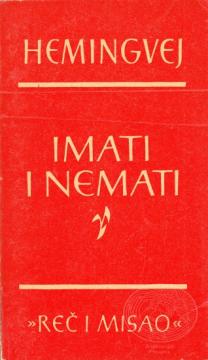
Imati i nemati

To Have and Have Not (1937) follows Harry Morgan, who during the Great Depression engages in smuggling and illegal business to survive. The novel sharply contrasts the rich and the poor, depicting the struggle for survival in a harsh world.
To Have and Have Not is one of Ernest Hemingway's most realistic and socially engaged novels. The story is set in Key West, Florida, and Cuba during the Great Depression.
The main character is Harry Morgan, a strong, determined, and fearless ship captain who makes a living by taking tourists out to sea, and later, desperate for poverty, gets involved in dangerous illegal businesses – smuggling alcohol, weapons, and people between Cuba and Florida. The novel follows his struggle for the survival of his family amidst widespread misery, corruption, and hopelessness.
Hemingway masterfully contrasts two worlds: the world of wealthy tourists and yachtsmen who idly enjoy luxury, and the world of poor fishermen, workers, and criminals who struggle for a bare existence. It is Hemingway's most direct social criticism – a sharp picture of class divides, capitalism, and moral decay.
The style is typically Hemingwayian: short sentences, strong dialogue, and raw male energy. The novel is also known for the character of Harry's wife, Marie, who is one of the few strong female characters in his work.
To Have and Have Not represents a transition in Hemingway's work towards greater social engagement and is considered an important work of American literature of the 1930s. A dynamic, tense and bitterly realistic novel about survival, honor and the price of poverty.
One copy is available