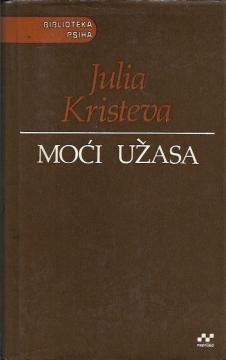
Moći užasa: Ogled o zazornosti

Moći užasa: Ogled o zazornosti

Julia Kristeva

In The Powers of Horror, Julia Kristeva explores the concept of disgust – that which causes disgust and anxiety because it destroys the boundaries between self and other, purity and impurity, life and death.

In the book Powers of Horror: An Essay on Abomination (1980), philosopher and psychoanalyst Julia Kristeva develops a theory of the abomination as a fundamental boundary of identity and cultural order. The abomination is that which provokes repulsion, but also fascination – that which we repress because it threatens to destroy the boundary between “self” and “other”, pure and impure, life and death. Examples of the abomination are the body, blood, excretions, decomposition – anything that recalls human fragility and death. Kristeva explores how culture, religion and language shape the mechanisms by which the abomination is repressed in order to maintain order and subjective identity. She particularly analyses the relationship between mother and child, where the abomination appears as a transition from bodily symbiosis to symbolic, linguistic identity. The Powers of Horror brings together psychoanalysis, anthropology and aesthetics, offering a profound interpretation of language, the body and the fear of the disintegration of the subject.

"Why misery? Why is there this “something” that is neither subject nor object, but keeps coming back, rebelling, fascinating? It is not neurosis. We glimpse it in phobia, psychosis. It is the explosion that Freud touched upon, but perhaps avoided, and that psychoanalysis should be ever more eager to hear. Because history and society impose it on us. In horror. Do rituals, religions, art do nothing but repel disgust? Hence the strange revelation of literature: Dostoevsky, Lautréamont, Proust, Artaud and, very symptomatically, Céline. Here he is now, this inhabitant of the borders, without desire and place of his own, wandering, pain and laughter mixed together, a disgusted wanderer in a filthy world. This is the object of resentment."

Original title
Pouvoirs de L'horreur
Translation
Divina Marion
Editor
Muradif Kulenović, Gvozden Flego, Mirjana Dobrović
Graphics design
Ratko Janjić-Jobo
Dimensions
22 x 14 cm
Pages
260
Publisher
Naprijed, Zagreb, 1989.
 
Latin alphabet. Hardcover with dust jacket.
Language: Croatian.

One copy is available

Condition:Used, excellent condition
 

Are you interested in another book? You can search the offer using our search engine or browse books by category.

You may also be interested in these titles

McDonaldizacija društva

McDonaldizacija društva

George Ritzer

The book has become a classic because it accurately describes the world of Amazon, Uber, Netflix, and TikTok thirty years in advance. Ritzer does not curse fast food, but warns that if the whole of society turns into McDonald’s, we will remain full but hu

Jesenski i Turk, 1999.
Croatian. Latin alphabet. Paperback.
19.56
Glavne struje savremene filozofije: Istorijsko-kritički uvod

Glavne struje savremene filozofije: Istorijsko-kritički uvod

Wolfgang Stegmüller
Nolit, 1962.
Serbian. Latin alphabet. Hardcover.
16.24
Istorija srpske filozofije

Istorija srpske filozofije

Slobodan Žunjić

Slobodan Žunjić, in his book History of Serbian Philosophy, provides a comprehensive overview of the development of Serbian philosophical thought from the Middle Ages to the end of the 20th century. The work covers the period from the literacy of Serbs in

Plato, 2009.
Serbian. Cyrillic alphabet. Paperback.
27.98
Obilje i nasilje

Obilje i nasilje

Ivan Kuvačić
Naprijed, 1979.
Croatian. Latin alphabet. Hardcover.
7.98
O duhu otvorenosti: dimenzije misaonog nasleđa Radomira Konstantinovića

O duhu otvorenosti: dimenzije misaonog nasleđa Radomira Konstantinovića

The collection is an important contribution to the revitalization of Konstantinović's thought in the post-Yugoslav space, demonstrating that his critique of the rural mind remains relevant for understanding contemporary social and political pathologies.

Gradska biblioteka Subotica, 2016.
Serbian. Latin alphabet. Paperback.
7.32
Foucault

Foucault

Gilles Deleuze

Deleuze's Portrait of Foucault (1986) is not a monograph, but a creative "thinking with Foucault." It analyzes the archaeology of knowledge, introducing the concepts of archive, power, subjectification, and "fold" as crucial to Foucault's thought on knowl

Sandorf, 2023.
Croatian. Latin alphabet. Paperback.
11.86