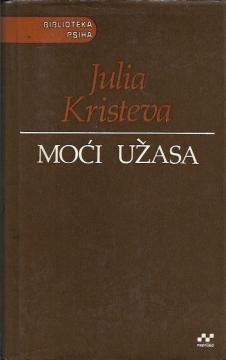
Moći užasa: Ogled o zazornosti

Moći užasa: Ogled o zazornosti

Julia Kristeva

In The Powers of Horror, Julia Kristeva explores the concept of disgust – that which causes disgust and anxiety because it destroys the boundaries between self and other, purity and impurity, life and death.

In the book Powers of Horror: An Essay on Abomination (1980), philosopher and psychoanalyst Julia Kristeva develops a theory of the abomination as a fundamental boundary of identity and cultural order. The abomination is that which provokes repulsion, but also fascination – that which we repress because it threatens to destroy the boundary between “self” and “other”, pure and impure, life and death. Examples of the abomination are the body, blood, excretions, decomposition – anything that recalls human fragility and death. Kristeva explores how culture, religion and language shape the mechanisms by which the abomination is repressed in order to maintain order and subjective identity. She particularly analyses the relationship between mother and child, where the abomination appears as a transition from bodily symbiosis to symbolic, linguistic identity. The Powers of Horror brings together psychoanalysis, anthropology and aesthetics, offering a profound interpretation of language, the body and the fear of the disintegration of the subject.

"Why misery? Why is there this “something” that is neither subject nor object, but keeps coming back, rebelling, fascinating? It is not neurosis. We glimpse it in phobia, psychosis. It is the explosion that Freud touched upon, but perhaps avoided, and that psychoanalysis should be ever more eager to hear. Because history and society impose it on us. In horror. Do rituals, religions, art do nothing but repel disgust? Hence the strange revelation of literature: Dostoevsky, Lautréamont, Proust, Artaud and, very symptomatically, Céline. Here he is now, this inhabitant of the borders, without desire and place of his own, wandering, pain and laughter mixed together, a disgusted wanderer in a filthy world. This is the object of resentment."

Naslov izvornika
Pouvoirs de L'horreur
Prijevod
Divina Marion
Urednik
Muradif Kulenović, Gvozden Flego, Mirjana Dobrović
Naslovnica
Ratko Janjić-Jobo
Dimenzije
22 x 14 cm
Broj strana
260
Nakladnik
Naprijed, Zagreb, 1989.
 
Latinica. Tvrde korice s ovitkom.
Jezik: Hrvatski.

Nema primjeraka u ponudi

Poslednji primjerak je nedavno prodan.
 

Zanima Vas i neka druga knjiga? Možete pretražiti našu ponudu pomoću tražilice ili prelistati knjige po kategorijama.

Možda će Vas zanimati i ovi naslovi

Logika smisla

Logika smisla

Gilles Deleuze

Gilles Deleuze's The Logic of Sense (1969) is one of his most important philosophical works. It explores the nature of sense, events, surfaces, and nonsense through the paradoxes of language, Stoic philosophy, and literature (Lewis Carroll).

Sandorf, 2015.
Hrvatski. Latinica. Broširano.
19,56
Suvremena filozofija Zapada

Suvremena filozofija Zapada

Danilo Pejović

This book is important for understanding the development of philosophy in the West and contributes to a wider dialogue on philosophical topics.

Matica hrvatska, 1999.
Hrvatski. Latinica. Broširano.
5,22
Što je filozofija?

Što je filozofija?

Gilles Deleuze, Félix Guattari

Deleuze and Guattari in What is philosophy? define philosophy as the creation of new concepts on the level of immanence, distinguishing it from science (function) and art (percepts and affects).

Sandorf, 2017.
Hrvatski. Latinica. Broširano.
16,00
Rajski brežuljci: Povijest moći i nemoći

Rajski brežuljci: Povijest moći i nemoći

Mineke Schipper

In her book, Mineke Schipper explores cultures throughout history to describe the complex relationship men have with the female body. Despite the symbiotic relationship between the sexes, men have always had greater power than women, and at the root of it

Durieux, 2021.
Hrvatski. Latinica. Tvrde korice s ovitkom.
16,54
Filozofija kao način življenja: Razgovor sa Žani Karlije i Arnoldom I. Dejvidsonom

Filozofija kao način življenja: Razgovor sa Žani Karlije i Arnoldom I. Dejvidsonom

Pierre Hadot

In the book of interviews, Pierre Hadot explains through his personal life story and conversations with Jeannie Carlier and Arnold I. Davidson why ancient philosophy was above all a way of life and a spiritual exercise, and not just theoretical knowledge.

Fedon, 2011.
Srpski. Latinica. Broširano s ovitkom.
17,32
Zanimljiva vremena, nemirna vremena: S Lešekom Kolakovskim razgovarao Zbignjev Mencel

Zanimljiva vremena, nemirna vremena: S Lešekom Kolakovskim razgovarao Zbignjev Mencel

Leszek Kolakowski

A book of interviews in which Kołakowski retrospectively describes his life and intellectual journey through the turbulent 20th century – from pre-war Poland, through Nazi occupation, Stalinism, revisionist Marxism, to exile in the West.

Službeni glasnik, 2009.
Srpski. Ćirilica. Broširano.
Knjiga se sastoji od dva toma
19,44