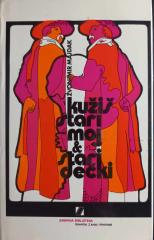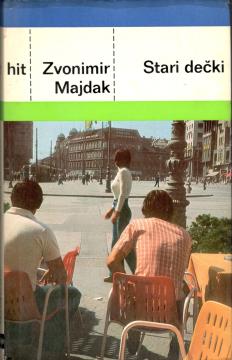
Stari dečki

Stari dečki

Zvonimir Majdak

The novel Stari dečki by Zvonimir Majdak, published in 1975, is a sequel to the cult novel Kužiš, stari moj and is part of his "prose in jeans", which is characterized by relaxed, Zagreb jargon mixed with a semi-Kajkavian style.

The story takes place in Zagreb during socialism, following the experiences of the narrator and his friend Glista, young people from the periphery who spend their lives in search of pleasure, without clear ambitions.

After the events of the first novel, Stari dečki deepens the story of their friendship and dealing with loss. The narrator thinks about the death of his friend, expecting the world to somehow react to the loss, but everyday life remains mercilessly the same – the trams are full, people act as if nothing has happened. Glista, still unhappy in love, sinks into depression after unsuccessful attempts to win over Gizela, the wife of their employer. An encounter with his idol Kurbla and the Bosnian Emina leads them into chaotic situations, including morally questionable events in the student dormitory. Glista's guilt forces him to confess, and after an encounter with the mysterious Milček, they end up in a madhouse. Glista's life is tragically cut short when he is run over by a tram.

The novel explores themes of loss, aimlessness, longing for a better life, and the brutality of everyday life, with Majdak's signature cynical humor and erotic motifs. Through vivid street language, Majdak portrays Zagreb's urban folklore and the social contrasts of the time, making the novel a faithful reflection of the life of an average Zagreb citizen.

Editor
Zlatko Crnković
Graphics design
Davor Šiftar
Dimensions
20 x 12.5 cm
Pages
202
Publisher
Znanje, Zagreb, 1975.
 
Latin alphabet. Hardcover with dust jacket.
Language: Croatian.

One copy is available

Condition:Used, excellent condition
 

Are you interested in another book? You can search the offer using our search engine or browse books by category.

You may also be interested in these titles

Krevet

Krevet

Zvonimir Majdak
Mladinska knjiga, 1990.
Croatian. Latin alphabet. Hardcover with dust jacket.
2.99
Pazi, tako da ostanem nevina

Pazi, tako da ostanem nevina

Zvonimir Majdak
Naprijed, 1986.
Croatian. Latin alphabet. Hardcover with dust jacket.
9.99
Dok ležah na samrti

Dok ležah na samrti

William Faulkner

Faulkner's 1930 novel, a classic example of modernist literature. It is often compared to Joyce's "Ulysses" for its innovative structure, but is more accessible due to its focus on family.

Rad, 1985.
Croatian. Latin alphabet. Paperback.
3.26
Magična ljubavna kutijica

Magična ljubavna kutijica

Santa Montefiore

The Magic Love Box (2002) follows the life story of Federica Campione, which begins in Vina del Mar, Chile, in the summer of 1982. Montefiore creates an epic story of growth, where the magic is not only in the box, but in the courage to let go of the past

Mozaik knjiga, 2006.
Croatian. Latin alphabet. Hardcover.
7.34
Andrićeva lestvica užasa

Andrićeva lestvica užasa

Svetislav Basara

A Serbian writer known for his satirical novels, Andrić's Ladder of Horrors dissects the Balkan mentality through a parable of Yugo-nostalgia and national myths. The title alludes to Ivo Andrić as a litmus test for criticism – Balkans claim him or reject

24 sata, 2021.
Serbian. Latin alphabet. Paperback.
11.56
Deobe 1-3

Deobe 1-3

Dobrica Ćosić

This work, awarded the NIN Prize for that year, is considered one of the most significant in Serbian literature after World War II.

Prosveta, 1961.
Serbian. Cyrillic alphabet. Hardcover with dust jacket.
The book consists of 3 volumes
11.42