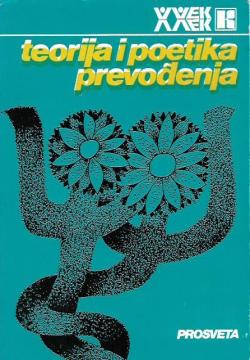
Teorija i poetika prevođenja

Teorija i poetika prevođenja

Ranko Bugarski, Miodrag Sibinović, Radivoje Konstantinović, Nikola Bertolino, Ljubiša Rajić, Dragoslav Andrić
Editor
Ljubiša Rajić
Graphics design
Ivan Mesner
Dimensions
16 x 11.5 cm
Pages
283
Publisher
Biblioteka XX vek, Beograd, 1981.
 
Latin alphabet. Paperback.
Language: Croatian.

No copies available

The last copy was sold recently.
 

Are you interested in another book? You can search the offer using our search engine or browse books by category.

You may also be interested in these titles

Jezik i lingvistika

Jezik i lingvistika

Ranko Bugarski

Ranko Bugarski, a distinguished linguist, in his book Language and Linguistics provides a clear and accessible overview of basic linguistic terms and methods.

Nolit, 1972.
Croatian. Latin alphabet. Paperback.
4.26
Engleski jezik na državnoj maturi

Engleski jezik na državnoj maturi

Steven Hindlaugh, Brankica Bošnjak Terzić, Melita Jurković
Školska knjiga, 2010.
Croatian. Latin alphabet. Paperback.
17.22
Slavenski blagovjesnici sveti Ćiril i Metod

Slavenski blagovjesnici sveti Ćiril i Metod

Franc Grivec

The book analyzes the life and work of Cyril and Methodius, as well as the sources that inform us about it.

Kršćanska sadašnjost, 1985.
Croatian. Latin alphabet. Paperback.
7.64
Zaustaviti izumiranje jezikâ

Zaustaviti izumiranje jezikâ

Claude Hagège

The author bases his research on the insight that - if nothing changes - in about a hundred years, out of today's approximately 5,000 living languages, half of them will die out. He is particularly worried about the fact that this cataclysm is taking plac

Disput, 2005.
Croatian. Latin alphabet. Hardcover.
18.24
Semiologija

Semiologija

Pierre Guiraud

Guiraud defines semiology as the science of signs and sign systems. He starts from Saussure's idea that language is the model for the study of all other signs.

Prosveta, 1983.
Serbian. Latin alphabet. Paperback.
4.98
Hrvatski naš svagda(š)nji

Hrvatski naš svagda(š)nji

Stjepko Težak

Words are like people: they are born, grow, travel, cross the borders of municipalities, provinces and states, adapt, change nationality and citizenship, reproduce, age and die, and – unlike people, similar to gods – they can also be resurrected.

Školske novine, 1990.
Croatian. Latin alphabet. Hardcover.
4.24