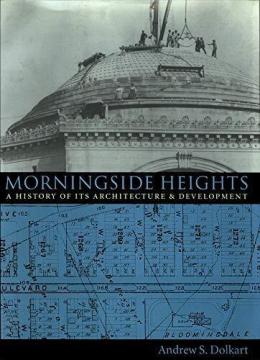
Morningside Heights: A History of Its Architecture and Development

Morningside Heights: A History of Its Architecture and Development

Andrew S. Dolkart

Morningside Heights, the institutional heart of New York City, is also one of the city's most architecturally distinguished neighborhoods.

The high plateau that forms Morningside Heights is geographically isolated within the city and remained largely undeveloped even as neighboring Harlem and the Upper West Side became prestigious residential communities. At the end of the nineteenth century, institutions relocated to the plateau where sizable plots were available at a convenient distance from the built-up city. In 1887 Episcopal Bishop Henry Potter announced plans for the construction of a great cathedral at the edge of the plateau. The cathedral was soon followed by Columbia College and St. Luke's Hospital, which contemplated grand complexes, and by newer institutions such as Barnard College and Teachers College that were intent on establishing a presence in the rapidly growing city. Thus, Morningside Heights became indelibly associated with New York's educational, medical, and religious foundations, and was appropriately dubbed "the Acropolis of New York."

Dimensions
25 x 18 cm
Pages
544
Publisher
Columbia University Press, New York, 2001.
 
Latin alphabet. Paperback.
Language: English.
ISBN
978-0-23107-851-1

One copy is available

Condition:Used, excellent condition
 

Are you interested in another book? You can search the offer using our search engine or browse books by category.

You may also be interested in these titles

Zagreb 1910.–1913.

Zagreb 1910.–1913.

Vjekoslav Klaić

"Zagreb 1910–1913" by Vjekoslav Klaić is a monograph on the development of Zagreb on the eve of World War I – an urban, cultural, economic and political overview of the city at the turn of the 19th and 20th centuries.

Knjižarnica Lavoslava Hartmana, 1918.
Croatian. Latin alphabet. Paperback.
14.26
Istorija arhitekture stari vijek

Istorija arhitekture stari vijek

Husref Redžić

Der Autor stellt die wichtigsten Architekturstile, Konstruktionstechniken und kulturellen Einflüsse vor, die die Architektur im Laufe der Geschichte geprägt haben.

Zavod za izdavanje udžbenika, 1969.
Croatian. Latin alphabet. Hardcover with dust jacket.
12.00
Slaveni u renesansi

Slaveni u renesansi

Slobodan Prosperov Novak

Eine außergewöhnliche, umfangreiche interdisziplinäre Monographie von Slobodan Prosperov Novak über die Slawen und ihre Bemühungen im 15. und 16. Jahrhundert, sich ihren westeuropäischen Zeitgenossen und Vorbildern unter dem Einfluss der italienischen Ren

Matica hrvatska, 2009.
Croatian. Latin alphabet. Hardcover with dust jacket.
23.90
O Zagrebu i...

O Zagrebu i...

Zrinka Paladino

Die bekannte Architektin, Restauratorin und Kolumnistin Zrinka Paladino legt eine umfassende Chronik Zagrebs vor – seiner Architektur, seiner Zerstörungen und seiner Gesellschaft. Erstmals alle Kolumnen an einem Ort, ergänzt durch neue Texte, Illustration

Telegram, 2021.
Croatian. Latin alphabet. Paperback.
19.98
Od ideje do realizacije

Od ideje do realizacije

Mirjana Mikulec

Nach einer Reihe von Büchern, die sich kleinen Wohnungen, Wohnräumen und anderen Besonderheiten der Inneneinrichtung widmen, hat Mirjana Mikulec auch ein Buch geschrieben, das als Handbuch für jeden dienen soll, der ein Zuhause von Grund auf einrichtet.

Domus nobilis, 2017.
Croatian. Latin alphabet. Paperback.
6.64
Palača cara Dioklecijana u Splitu

Palača cara Dioklecijana u Splitu

Frane Bulić, Ljubo Karaman

The work of Bulić and Karaman depicts the creation and development of Diocletian's Palace in Split, its historical transformation and significance as a monument of Roman architecture and later an urban center.

Matica hrvatska, 1927.
Croatian. Latin alphabet. Hardcover.
12.46