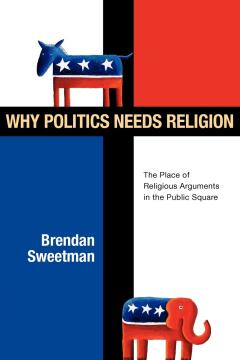
Why Politics Needs Religion: The Place of Religious Arguments in the Public Square

Why Politics Needs Religion: The Place of Religious Arguments in the Public Square

Brendan Sweetman

Can religion and politics mix? Many voices reply, "No way!" Yet in this provocative and timely book, Brendan Sweetman argues against this charge and the various sophisticated arguments that support it.

As we witness the clash of religious and secular worldviews he claims that our pluralistic democratic society will be best served when the faith elements of secularism are acknowledged and the rational elements of religious arguments are allowed to inform the momentous debates taking place in the public square. In fact, Sweetman contends that "politics needs religion if it is to be truly democratic, concerned with fairness among worldviews, equality and a vigorous public discussion."

Dimensions
23 x 15.5 cm
Pages
256
Publisher
Inter Varsity Press, Westmont, Illinois, 2006.
 
Latin alphabet. Paperback.
Language: English.

One copy is available

Condition:Unused
 

Are you interested in another book? You can search the offer using our search engine or browse books by category.

You may also be interested in these titles

Kako stoje stvari: Predavanje održano u Domu JNA u Zagrebu 17. 12. 1952.

Kako stoje stvari: Predavanje održano u Domu JNA u Zagrebu 17. 12. 1952.

Miroslav Krleža

In his lecture How Things Are (1952), Krleža discusses the political and cultural situation of post-war Yugoslavia, emphasizing the need for critical thought, cultural renewal, and resistance to dogmatism.

Zora, 1953.
Croatian. Latin alphabet. Paperback.
12.48
Programi i manifesti u hrvatskoj književnosti

Programi i manifesti u hrvatskoj književnosti

Miroslav Šicel

The collection "Programs and Manifestos in Croatian Literature", edited by Miroslav Šicel and published by Liber in 1972, represents a key collection of texts that shaped the direction of Croatian literature through various historical phases.

Liber, 1972.
Croatian. Latin alphabet. Paperback with dust jacket.
6.24
Kronika kulta ličnosti

Kronika kulta ličnosti

Jevgenija Ginzburg

Chronicle of the Cult of Personality by Yevgenia Ginzburg is a memoir about the Stalinist purges. The author describes her own arrest, imprisonment, and years spent in camps, testifying to the repression of the Soviet regime.

Znanje, 1971.
Croatian. Latin alphabet. Hardcover with dust jacket.
6.48
Dnevnik 1: Dnevnik 1914 - 17 (Davni dani I)

Dnevnik 1: Dnevnik 1914 - 17 (Davni dani I)

Miroslav Krleža

The 1914–17 diary records Krleža's writings from the First World War: personal dilemmas, pacifism, conflict with the militarism of the Monarchy, and intellectual maturation in the years of the collapse of the old world.

NIŠRO Oslobođenje, 1981.
Croatian. Latin alphabet. Hardcover.
6.78
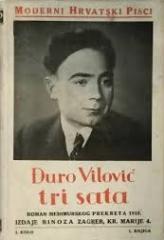
Tri sata: Roman međimurskog preokreta 1918.

Tri sata: Roman međimurskog preokreta 1918.

Đuro Vilović

The work, first published in 1935, provides a documentary account of events related to the liberation of Međimurje from Hungarian rule and its annexation to the Kingdom of Serbs, Croats and Slovenes in 1918.

Naklada Binoza, 1935.
Croatian. Latin alphabet. Hardcover.
7.95
Modra bilježnica

Modra bilježnica

Emanuil Kazakevič

The novel depicts the last days of Vladimir Ilyich Lenin on the eve of the October Revolution. Through his thoughts and actions, it depicts the struggle for social change.

Naprijed, 1967.
Croatian. Latin alphabet. Hardcover with dust jacket.
3.99 - 7.32