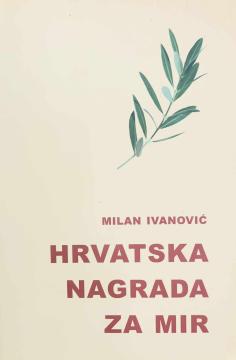
Hrvatska nagrada za mir

Hrvatska nagrada za mir

Milan Ivanović

Peace, as a social-individual category and desire, historically speaking, is the old dream of the sages of the always restless humanity exposed to the sufferings and violence of war.

The first part of the book gives a brief overview of the history of peace awards in the world and shows some of the most important peace awards on all continents with an emphasis on a selection of the more famous in European countries and a special analysis of the situation in post-socialist transition countries. The second part of the book presents all the winners: (a) "Krunoslav Sukić" awards, (b) "Krunoslav Sukić" awards for work in the local community, non-violent action of the year and similar activities as well as special awards, and (c) "Krunoslav Sukić" awards Krunoslav Sukić" Book of the Year, (d) Awards "Peaceful School". In the third part of the book - Concluding considerations - the conclusions of the analysis are given: - how to promote just, peaceful and inclusive societies; - how peace organizations make significant contributions to the construction of civil society in Croatia, - the concept of the peace prize as a social project is clarified, and - recommendations for the future are given.

Editor
Renata Trischler
Graphics design
Ladislav Bognar
Dimensions
24 x 17 cm
Pages
182
Publisher
Alberta naklada, Osijek, 2019.
 
Distribution: 500 copies
 
Latin alphabet. Paperback.
Language: Croatian.

One copy is available

Condition:Used, excellent condition
Discounted price: 5.364.02
25% discount is valid until 6/17/26 11:59 pm
 

Are you interested in another book? You can search the offer using our search engine or browse books by category.

You may also be interested in these titles

Hrvatski narodni vladari od god. 620.–1102.

Hrvatski narodni vladari od god. 620.–1102.

Mate Sagher

A pioneering attempt at a systematic presentation of Croatian political history from the settlement of Croats to the conclusion of a personal union with Hungary. Segher chronologically traces the development of Croatian statehood, relying on the sources a

Dionička tiskara, 1903.
Croatian. Latin alphabet. Paperback.
14.76
Vodič kroz grad Osijek

Vodič kroz grad Osijek

An important document reflecting the state of the city immediately after World War II. The guide served as a practical tool for orientation and informing citizens and visitors about the urban layout and infrastructure of the city at that time.

Gradski N. O., Građevinski odjel u Osijeku, 1946.
Croatian. Latin alphabet. Paperback.
64.28
Split

Split

Jure Kaštelan, Duško Kečmenet, Joško Carević

Split is a true tourist paradise. Its squares, streets and buildings showcase a wide range of styles.

Grafički zavod Hrvatske (GZH), 1970.
Croatian. Latin alphabet. Hardcover with dust jacket.
11.98
Osječka groblja

Osječka groblja

Stjepan Sršan

The book is deeply rooted in the local history and culture of Osijek, with an emphasis on cemetery motifs that serve as a metaphor for memory, death, and disappearance.

Povijesni arhiv u Osijeku, 1996.
Croatian. Latin alphabet. Paperback.
5.264.21
Korčulanska brodogradnja / Shipbuilding in Korčula

Korčulanska brodogradnja / Shipbuilding in Korčula

Dušan Kalogjera

The monograph Korčula Shipbuilding by Dušan Kalogjera explores the rich history of shipbuilding on the island of Korčula, a key center of Adriatic maritime tradition from the Middle Ages to the present day.

Prometej, 1998.
Croatian. Latin alphabet. Hardcover with dust jacket.
87.32
Toma Splićanin - državnik i pisac (1200.-1268.): njegovo život i njegovo djelo

Toma Splićanin - državnik i pisac (1200.-1268.): njegovo život i njegovo djelo

Cherubin Šegvić

The first comprehensive monograph on Thomas the Archdeacon, a 13th-century Split cleric, chronicler, and statesman. The work represents a significant contribution to Croatian historiography, providing insight into the life and work of one of the key figur

Matica hrvatska, 1927.
Croatian. Latin alphabet. Hardcover.
12.56