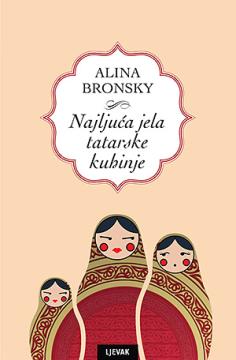
Najljuća jela tatarske kuhinje
Rare book

Najljuća jela tatarske kuhinje

Alina Bronsky

The main character, Rosa Ahmetovna, is an extremely self-centered, intrusive, tactless, sly and cunning narrator in this family saga by the author of the acclaimed novel "Scherbenpark" Alina Bronsky.

When Rosa Akhmetovna discovers that her seventeen-year-old daughter, "stupid Sulfia", is pregnant, and that the father of the child is unknown, she stops at nothing in an effort to induce an abortion, using various "folk recipes" for such cases.

But despite all her attempts, her plan backfired and Sulfija gave birth to a daughter, Aminat, in the Soviet Birth Center No. 134, who, to Rosa's great surprise and joy, is a "real Tatar" like her grandmother. While Rosa's husband Kalganov lazes in the park feeding pigeons and thinking about death, Rosa embarks on an epic battle to wrest Aminat away from Sulfia, whom she sees as a woefully incompetent mother.

When Aminat grows up a little and turns into a wild and self-willed teenager, she catches the eye of a sleazy German cookbook author who is researching Tatar cuisine, and Rosa uses his inappropriate affection for her underage granddaughter to make a deal with him that will allow the three women from the Ahmetov family to escape from the gloomy and difficult life in the Soviet Union.

But as soon as they find themselves in the West, the dysfunctional bonds that connect mother, daughter and granddaughter begin to crack.

Original title
Die schärfsten Gerichte der tatarischen Küche
Translation
Boris Perić
Editor
Nada Brnardić
Dimensions
20.5 x 13.5 cm
Pages
304
Publisher
Naklada Ljevak, Zagreb, 2014.
 
Latin alphabet. Paperback.
Language: Croatian.
ISBN
978-9-53303-699-1

One copy is available

Condition:Unused
 

Are you interested in another book? You can search the offer using our search engine or browse books by category.

You may also be interested in these titles

Hromi plemić

Hromi plemić

Aleksej N. Tolstoj
Progres.
Serbian. Latin alphabet. Paperback.
4.99
Problem ćelije broj 13

Problem ćelije broj 13

Jacques Futrelle
Europapress holding, 2009.
Croatian. Latin alphabet. Paperback.
1.98
Posljednja konkubina

Posljednja konkubina

Lesley Downer

The year is 1861. Growing up deep in the mountains of Japan, Sachi has always felt different.

Oceanmore, 2009.
Croatian. Latin alphabet. Paperback.
11.96
Djeca ljeta

Djeca ljeta

Robert Sabatier

The pisano has its own meaning, it has many sensibilities, a poet's disposition is also available and the pisca can be re-entered. Djeca ljeta se ne čitaju, čitalac se šeta kroz roman kao kroz prekrasnu aleju od čempresa.

Otokar Keršovani, 1982.
Croatian. Latin alphabet. Hardcover with dust jacket.
3.98
Seljačka buna

Seljačka buna

August Šenoa

August Šenoa's historical novel, which was published in Vijenec in 1877, and was published as a book in 1878. The novel is subtitled "Historical Narrative XVI. century" so it can be seen as a historical monograph in the form of a novel.

Spektar, 1974.
Croatian. Latin alphabet. Hardcover.
6.58
Kao voda za čokoladu

Kao voda za čokoladu

Laura Esquivel

One of the most successful works of Spanish literature, originally witty, magically touching and unrelentingly tragic, this love story will win you over just as it won the hearts of millions of readers around the world with its true-to-life charm.

Vorto palabra, 2020.
Croatian. Latin alphabet. Paperback.
8.36