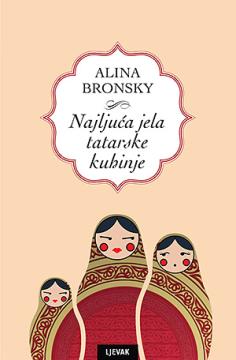
Najljuća jela tatarske kuhinje
Rare book

Najljuća jela tatarske kuhinje

Alina Bronsky

The main character, Rosa Ahmetovna, is an extremely self-centered, intrusive, tactless, sly and cunning narrator in this family saga by the author of the acclaimed novel "Scherbenpark" Alina Bronsky.

When Rosa Akhmetovna discovers that her seventeen-year-old daughter, "stupid Sulfia", is pregnant, and that the father of the child is unknown, she stops at nothing in an effort to induce an abortion, using various "folk recipes" for such cases.

But despite all her attempts, her plan backfired and Sulfija gave birth to a daughter, Aminat, in the Soviet Birth Center No. 134, who, to Rosa's great surprise and joy, is a "real Tatar" like her grandmother. While Rosa's husband Kalganov lazes in the park feeding pigeons and thinking about death, Rosa embarks on an epic battle to wrest Aminat away from Sulfia, whom she sees as a woefully incompetent mother.

When Aminat grows up a little and turns into a wild and self-willed teenager, she catches the eye of a sleazy German cookbook author who is researching Tatar cuisine, and Rosa uses his inappropriate affection for her underage granddaughter to make a deal with him that will allow the three women from the Ahmetov family to escape from the gloomy and difficult life in the Soviet Union.

But as soon as they find themselves in the West, the dysfunctional bonds that connect mother, daughter and granddaughter begin to crack.

Original title
Die schärfsten Gerichte der tatarischen Küche
Translation
Boris Perić
Editor
Nada Brnardić
Dimensions
20.5 x 13.5 cm
Pages
304
Publisher
Naklada Ljevak, Zagreb, 2014.
 
Latin alphabet. Paperback.
Language: Croatian.
ISBN
978-9-53303-699-1

One copy is available

Condition:Unused
 

Are you interested in another book? You can search the offer using our search engine or browse books by category.

You may also be interested in these titles

Razbojnici

Razbojnici

Friedrich Schiller

A 1782 play by Friedrich Schiller, a key work of the Sturm und Drang movement. The plot revolves around the conflict between two brothers from the Moor family, Karl and Franz, and explores the themes of freedom, morality and social justice.

Europapress holding, 2008.
Croatian. Latin alphabet. Hardcover.
5.32
Proces

Proces

Franz Kafka

Kafka wrote The Process between 1914 and 1915, published posthumously in 1925. The novel is unfinished but with an added final chapter by Max Brod. Edition with a foreword by B. Živojinović and an afterword by Walter Killi.

BIGZ, 1990.
Serbian. Latin alphabet. Paperback.
4.26
Zatočenik pustinje

Zatočenik pustinje

Heinz G. Konsalik

A doctor, oil, unknown diseases, a brave nurse... Enough for the book to arouse the interest of female readers.

Mladinska knjiga, 1992.
Croatian. Latin alphabet. Hardcover with dust jacket.
1.76
Hura, još živimo

Hura, još živimo

Johannes M. Simmel

The novel follows the life of Jakob Formann from 1946 to 1976: from a poor returnee from the war, through business ups and downs, love, marriages and scandals, to becoming one of the richest and most famous people in Germany.

Mladost, 1980.
Croatian. Latin alphabet. Hardcover with dust jacket.
6.48
Osuđen na uspjeh

Osuđen na uspjeh

Hans Hellmut Kirst

In this work, the character of police inspector Keller appears for the first time, who fights crime with unusual methods.

Prosveta, 1987.
Croatian. Latin alphabet. Paperback.
4.98
Dnevnici, 1. svezak: 1909-1912.

Dnevnici, 1. svezak: 1909-1912.

Franz Kafka

Kafka's diaries, published posthumously, reveal the inner world of an anxious genius. The first volume covers his early years, when Kafka worked as an insurance clerk in Prague, faced with a dreary life and literary ambitions.

Tim press, 2022.
Croatian. Latin alphabet. Paperback.
15.42