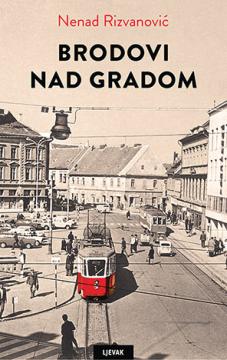
Brodovi nad gradom

Brodovi nad gradom

Nenad Rizvanović

Nenad Rizvanović is a writer of memories and a writer of Osijek, the city of his childhood and youth, who documents the only way in which literature is truly created - its people.

Brodovi nad gradom is a book of Osijek's very intimate topography, from Turkish history, through the nineteenth-century spatial (lack of) self-awareness of Osijek to Osijek's "socialist renaissance", a story about a city that gives the friendly eye of the storyteller little secret insights into spaces, buildings, mysterious street networks, into historical sediments that are reflected in the changes in the names of streets and squares, in Pannonian mildness and stubbornness. Osijek, Yugoslavia, is the narrator's childhood heterotopia recreated in the story of his own surreal urban genetic code.

At the beginning of Nenad Rizvanović's book Ships over the City, a motto from Walter Benjamin's childhood in Berlin is stated about wandering through the city as a sensory skill in which detail and emotion merge, about the city as a metaphorical forest through which we wander in a sweet haze of deliberate disorientation. Adopting this motto almost literally, Rizvanović's Osijek in the book becomes a historical symbolic forest through which the unnamed narrator wanders, mapping in his mind the networks of Osijek's alternative city history and gossip, finding paradoxical coincidences between the historical memory of the city and his own upbringing in the same city.

Editor
Dubravka Zima
Illustrations
Krešimir Lendić, Stjepan Kes, Željko Stojanović
Graphics design
Ana Pojatina
Dimensions
21 x 14 cm
Pages
184
Publisher
Naklada Ljevak, Zagreb, 2023.
 
Latin alphabet. Hardcover with dust jacket.
Language: Croatian.
ISBN
978-9-53355-696-3

No copies available

The last copy was sold recently.
 

Are you interested in another book? You can search the offer using our search engine or browse books by category.

You may also be interested in these titles

Antidnevnik prisjećanja: Pogled unatrag i unaprijed

Antidnevnik prisjećanja: Pogled unatrag i unaprijed

Vladimir Devidé

Vladimir Devidé, a Croatian mathematician, Japanologist and essayist, creates an intimate, fragmentary autobiography in Anti-Diary of Recollections through around twenty texts – essays, stories, humorous and satirical articles, travelogues, reflections an

Znanje, 1995.
Croatian. Latin alphabet. Paperback.
11.26
Gustave Flaubert

Gustave Flaubert

Émile Zola
Nakladni zavod Hrvatske, 1948.
Croatian. Latin alphabet. Paperback.
3.76
Poezija i zbilja

Poezija i zbilja

Johann Wolfgang Goethe

Goethe's greatest autobiographical prose, written between 1811 and 1833, covers his life from his birth in 1749 in Frankfurt to 1775, when he went to Weimar at the invitation of Duke Karl August.

Matica hrvatska, 1953.
Croatian. Latin alphabet. Hardcover with dust jacket.
18.42
Imenik lijepih vještina I-II

Imenik lijepih vještina I-II

Miljenko Jergović

In The Directory of Fine Arts, Miljenko Jergović explores diverse topics, from literature to history, celebrating art and excellence. His essays offer deep understanding, imbued with intellectual passion and a love of the written word.

24 sata, 2018.
Croatian. Latin alphabet. Hardcover with dust jacket.
The book consists of two volumes
34.56
Razgovori s Krležom

Razgovori s Krležom

Predrag Matvejević

The book "Conversations with Krleža" by Predrag Matvejević provides a deep insight into the relationship of culture to the great writer Miroslav Krleža.

BIGZ, 1987.
Croatian. Latin alphabet. Paperback.
4.983.98
I drugi su pjevali o ratu: Odjeci raspada Jugoslavije u engleskoj i američkoj književnosti

I drugi su pjevali o ratu: Odjeci raspada Jugoslavije u engleskoj i američkoj književnosti

Muharem Bazdulj

In this book of essays, Muharem Bazdulj analyzes how the collapse of Yugoslavia and the wars of the 1990s resonated in Anglo-Saxon literature – from pre-war stereotypes to war and post-war depictions.

Biblioteka XX vek, 2013.
Croatian. Latin alphabet. Paperback.
8.24