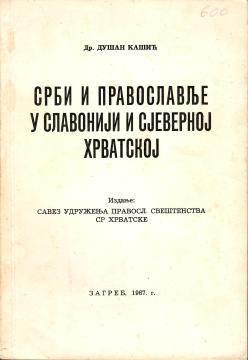
Srbi i pravoslavlje u Slavoniji i sjevernoj Hrvatskoj

Srbi i pravoslavlje u Slavoniji i sjevernoj Hrvatskoj

Dušan Lj. Kašić

"Serbs and Orthodoxy in Slavonia and Northern Croatia" by Dušan Kašić is a historical and sociological work that analyzes the history, culture and religious life of Orthodox Serbs in Slavonia and northern Croatia.

The book deals with the identity of Serbs of the Orthodox faith in this part of Croatia through historical development, from the arrival of Orthodox communities in these areas to their position in modern social circumstances.

Kašić describes in detail the historical context of the arrival of Orthodox Serbs in Slavonia and northern Croatia. Certain waves of settlement are connected with the Turkish conquests during the 16th and 17th centuries and the Habsburg Monarchy, which provided Orthodox settlers with certain privileges through the Statute of 1690. Orthodox Serbs were an important part of the Military Border system, where they served as border guards and at the same time developed their own religious and cultural institutions.

The author investigates the role of the Serbian Orthodox Church in preserving the national and religious identity of the Serbs in this area. Kašić describes the construction and significance of Orthodox temples and monasteries, which were centers of spiritual and cultural life. The role of the church extends to education and the spread of literacy, with Orthodox schools playing a key role in preserving language and tradition.

The book analyzes mutual relations between Orthodox Serbs and other ethnic and religious groups in Slavonia and northern Croatia. Although there were conflicts, especially during periods of national tension in the 19th and 20th centuries, the author also points to periods of mutual coexistence and cooperation. Special emphasis is placed on the influence of political changes and wars on the position of Serbs and their religious communities, including the period of the Kingdom of Yugoslavia, NDH and socialist Yugoslavia.

Editor
Ratko Jelić
Dimensions
20 x 13.5 cm
Pages
140
Publisher
Savez udruženja pravoslavnog sveštenstva SR Hrvatske, Zagreb, 1967.
 
Cyrillic alphabet. Paperback.
Language: Croatian.

No copies available

The last copy was sold recently.
 

Are you interested in another book? You can search the offer using our search engine or browse books by category.

You may also be interested in these titles

Povijest Hrvatske 1945-2011. (2.svezak)

Povijest Hrvatske 1945-2011. (2.svezak)

Ivo Goldstein

Goldstein's "History of Croatia" is one of the most reliable books published in the past period, especially rich in historical works.

EPH media d. o. o., 2011.
Croatian. Latin alphabet. Paperback.
5.223.92
Zapisi o životu i običajima Slavonaca

Zapisi o životu i običajima Slavonaca

Ante Duić-Dunja
Gradski muzej Vukovar, 1982.
Croatian. Latin alphabet. Paperback.
8.326.24
Narodni heroj: Božidar Dakić (svezak 17)

Narodni heroj: Božidar Dakić (svezak 17)

Jakov Sekulić
Izdavačko poduzeće "27. srpanj", 1954.
Croatian. Latin alphabet. Paperback.
2.98
Osječka groblja

Osječka groblja

Stjepan Sršan

The book is deeply rooted in the local history and culture of Osijek, with an emphasis on cemetery motifs that serve as a metaphor for memory, death, and disappearance.

Povijesni arhiv u Osijeku, 1996.
Croatian. Latin alphabet. Paperback.
5.26
Od Pola do Malnara: Putnici i istraživači u hrvatskoj kulturi od 13. do 20. stoljeća

Od Pola do Malnara: Putnici i istraživači u hrvatskoj kulturi od 13. do 20. stoljeća

Juraj Bubalo

The book by Zagreb travel writer and professor Juraj Bubalo is a kind of encyclopedia of Croatian travelers and explorers. Unique in Croatian non-fiction, it popularizes the culture of exploration and reminds us that Croats have been part of global discov

Meridijani, 2024.
Croatian. Latin alphabet. Hardcover.
28.32
Komunizam i čovjek: Odnos vlasti i pojedinca u Hrvatskoj (1958.–1972.)

Komunizam i čovjek: Odnos vlasti i pojedinca u Hrvatskoj (1958.–1972.)

Josip Mihaljević

Josip Mihaljević's book analyzes the relationship between the government and the individual in communist Croatia (1958–1972), through repressive mechanisms, ideological pressures, and restrictions on personal freedom in the socialist system.

Hrvatski institut za povijest, 2016.
Croatian. Latin alphabet. Hardcover.
17.26