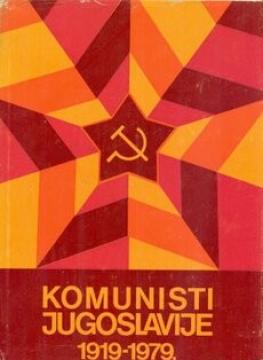
Komunisti Jugoslavije 1919-1979.

Komunisti Jugoslavije 1919-1979.

Pero Morača, Stanislav Stojanović

The book provides an overview of the history of the Communist Party of Yugoslavia (KPJ) from its founding to the late 1970s, emphasizing its role in the revolution, self-government, and construction of Yugoslavia, with an ideologically colored perspective

The work describes in detail the formation of the KPJ in 1919 as the Socialist Workers' Party of Yugoslavia (communists) at the Congress in Belgrade, its struggle during the illegality in the Kingdom of Yugoslavia, its role in the People's Liberation War (NOB) from 1941 to 1945, and its transformation into the SKJ in 1952 under the leadership of Josip Broz Tito.

The authors emphasize key phases: from early conflicts with the authorities, through the 1920 ban (Obznań) and repression, to the organization of an armed uprising against the occupiers in World War II. The conflicts with the Comintern and the split with Stalin in 1948 are highlighted, which led to the development of a specific Yugoslav model of socialism - self-management. The book also analyzes internal factional struggles, especially between the left and the right, and the role of the KPJ/SKJ in the construction of socialist Yugoslavia, including economic and social reforms.

Written from the perspective of official historiography, the book celebrates the achievements of the Communist Party of Yugoslavia but avoids a deeper critique of the crimes and repression. It is intended for a wider audience and experts, providing a chronology of key events, such as the founding of republican parties and the conflict with the Informbiro.

Editor
Dušan Maletić
Graphics design
Ivan Mesner
Dimensions
29 x 20.5 cm
Pages
332
Publisher
Eksportpres, Beograd, 1979.
 
Distribution: 10,000 copies
 
Latin alphabet. Hardcover with dust jacket.
Language: Serbian.

One copy is available

Condition:Used, excellent condition
Damages or inconvenience notice:
  • Slight damage to the dust jacket
 

Are you interested in another book? You can search the offer using our search engine or browse books by category.

You may also be interested in these titles

Komunizam i čovjek: Odnos vlasti i pojedinca u Hrvatskoj (1958.–1972.)

Komunizam i čovjek: Odnos vlasti i pojedinca u Hrvatskoj (1958.–1972.)

Josip Mihaljević

Josip Mihaljević's book analyzes the relationship between the government and the individual in communist Croatia (1958–1972), through repressive mechanisms, ideological pressures, and restrictions on personal freedom in the socialist system.

Hrvatski institut za povijest, 2016.
Croatian. Latin alphabet. Hardcover.
17.26
Sam protiv njih

Sam protiv njih

Roman Leljak

A non-fiction work by a Slovenian investigator of the UDB archives. The author, a former KOS employee, left the army after learning about the crimes of the Yugoslav army during the war and the post-war period, and dedicated himself to exposing the secret

Vlastita naklada, 1990.
Croatian. Latin alphabet. Paperback.
16.42
Metamorfoze Ruskog Carstva 1721. - 1921.: Geopolitika, ode i narodi

Metamorfoze Ruskog Carstva 1721. - 1921.: Geopolitika, ode i narodi

Andrzej Nowak

A historical study of the transformations of the Russian Empire from Peter the Great to the early USSR, focusing on imperial geopolitics, ideological patterns, and relations with peoples within the empire.

Fortuna d.o.o., 2023.
Croatian. Latin alphabet. Hardcover.
35.00
Golem: Geissel der Tschechen. Die Zersetzung des tschechischen Nationalismus

Golem: Geissel der Tschechen. Die Zersetzung des tschechischen Nationalismus

Walter Jacobi

Golem: The Czech Whip is a propaganda book published in occupied Prague in 1942, which attacks Czech nationalism and political resistance to Nazism through anti-Semitic and anti-Masonic motives.

Orbis-Verlag, 1942.
German. Latin alphabet. Hardcover.
18.36
YU-GENOCID: Bleiburg, Križni put, Udba

YU-GENOCID: Bleiburg, Križni put, Udba

Ante Beljo

A non-fiction book by Ante Belja about post-war liquidations, repression by the Yugoslav authorities and the activities of the UDBA, from the perspective of Croatian political emigration.

HIŠAK, 1990.
Croatian. Latin alphabet. Paperback.
12.34
Perestroika: Die zweite russische Revolution - Eine neue Politik für Europa und die Welt

Perestroika: Die zweite russische Revolution - Eine neue Politik für Europa und die Welt

Mihail S. Gorbačov

In the book, Mikhail Gorbachev explains perestroika as the second Russian revolution – a reform of Soviet society, economy and international politics. He advocates openness (glasnost), democracy and new cooperation with the West.

Bertelsmann Lesering, 1987.
German. Latin alphabet. Hardcover with dust jacket.
9.46