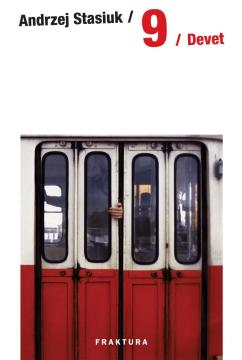
Devet

Devet

Andrzej Stasiuk

“Nine” (1999) by Andrzej Stasiuk, one of the most important contemporary Polish writers, is an unusual thriller that follows a small shopkeeper, Paweł, a modern-day Ulysses, whose life changes abruptly when debt collectors rob him and destroy his apartmen

In three days of wandering through the divided Warsaw of the late 1990s – from the bright to the dark side of the city – Paweł seeks salvation, meeting nine characters, from criminals, drug addicts, to ordinary girls and men. Through their stories, he experiences betrayals, fights, unrealized sexual adventures and profound symbolic encounters that reveal the chaos of post-communist Poland.

Stasiuk, born in 1960 in Warsaw, a former deserter and prisoner, lives in the Carpathians where he runs the Czarne publishing house. In “Nine” he combines pathos with lyricism, sarcasm with artistry, creating a poetic labyrinth of urban existence. The novel depicts a generation freed from ideology, but lost in alienation from family, neighbors and friends, more clearly than any study. Warsaw becomes Joyce’s Dublin – a metaphysical space of marginalized souls, where lust, violence and the melancholy of transition collide.

It ends abruptly, without resolution, without victory or defeat, leaving the reader in suspense. Praised for its linguistic sophistication and provocativeness, "Nine" is one of the best novels of the nineties, a bridge between European tradition and contemporary nightmare.

Original title
Dziewięć
Translation
Ivana Maslač
Editor
Seid Serdarević
Graphics design
Ana Baletić
Dimensions
20 x 14 cm
Pages
257
Publisher
Fraktura, Zaprešić, 2003.
 
Latin alphabet. Paperback.
Language: Croatian.

One copy is available

Condition:Used, excellent condition
Damages or inconvenience notice:
  • Traces of patina
 

Are you interested in another book? You can search the offer using our search engine or browse books by category.

You may also be interested in these titles

Usta puna zemlje

Usta puna zemlje

Branimir Šćepanović

The novel "Usta puna zemlje" (1970), the masterpiece of the Serbian writer Branimir Šćepanović, is a psychologically in-depth explorer of the limits of the human soul, solitude and existential freedom, reminiscent of Kafka and Camus.

BIGZ, 1987.
Serbian. Latin alphabet. Paperback.
3.98
Deobe

Deobe

Dobrica Ćosić

Deobe is a novel about the tragic division of Serbs into Chetniks and Partisans during World War II. Winner of the NIN Award, it is part of a wider epic trilogy, inspired by Ćosić's experiences and historical documents.

Prosveta, 1963.
Croatian. Latin alphabet. Hardcover with dust jacket.
13.74
Deobe 1-3

Deobe 1-3

Dobrica Ćosić

This work, awarded the NIN Prize for that year, is considered one of the most significant in Serbian literature after World War II.

Prosveta, 1961.
Serbian. Cyrillic alphabet. Hardcover with dust jacket.
The book consists of 3 volumes
11.42
Magična ljubavna kutijica

Magična ljubavna kutijica

Santa Montefiore

The Magic Love Box (2002) follows the life story of Federica Campione, which begins in Vina del Mar, Chile, in the summer of 1982. Montefiore creates an epic story of growth, where the magic is not only in the box, but in the courage to let go of the past

Mozaik knjiga, 2006.
Croatian. Latin alphabet. Hardcover.
7.34
Jedna Svanova ljubav

Jedna Svanova ljubav

Marcel Proust
Rad, 1984.
Serbian. Latin alphabet. Paperback.
2.98
Kreutzerova sonata, Hadži-Murat

Kreutzerova sonata, Hadži-Murat

Lav Nikolajevič Tolstoj

Kreutzer's sonata belongs to those works of Tolstoy that the writer adapted in many ways to his view on moral issues, on marital morality above all.

Civitas, 2004.
Croatian. Latin alphabet. Paperback.
4.98