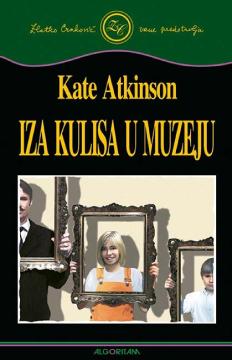
Iza kulisa u muzeju

Iza kulisa u muzeju

Kate Atkinson

Kate Atkinson's debut novel, told through the eyes of the youngest daughter in a dysfunctional Yorkshire family. Like museum exhibits, the characters are vivid, imperfect, a reminder that life behind the scenes is full of unexpected twists and turns.

Ruby begins her story from the moment of her conception in 1951 – an accidental one, in a hotel room during her sister Patricia’s wedding – where, as a fetus, she hears the inner monologues of her mother Bunty, a chronically unhappy woman trapped in a marriage with the gentle but indecisive George. Marked by postpartum depression after the births of Patricia and Deborah, Bunty sees life as an endless litany of disappointments: “Why does it always happen to me?”

The story expands into a multigenerational saga of “The Family,” beginning in the late 19th century, when great-grandmother Alice, a fragile beauty, runs away with the French photographer Reginald, leaving behind scandals and secrets. Across the generations – mother Nell, grandmother Clarissa – world wars, the loss of children (the death of little brother Billy in a fire), betrayals and obsessions with the past pass. Ruby, obsessed with museum objects that tell stories (like a wedding ring or a photograph), reconstructs the family history through humorous but painful anecdotes: Bunty's love affair with a fishmonger, Patricia's pregnancy, Deborah's rebellion.

Atkinson mixes humor, irony, and sad introspection, exploring themes of inheritance, loss, the impact of war on women, and identity in the chaos of family. Ruby's voice—smart, sarcastic, compassionate—makes the novel a timeless portrait of the English countryside, where every object holds a secret and every story heals wounds.

Original title
Behind the Scenes at the Museum
Translation
Anka Katušić Balen
Editor
Zlatko Crnković
Graphics design
Nenad Martić
Dimensions
24 x 15 cm
Pages
345
Publisher
Algoritam, Zagreb, 2000.
 
Latin alphabet. Hardcover.
Language: Croatian.

One copy is available

Condition:Unused
 

Are you interested in another book? You can search the offer using our search engine or browse books by category.

You may also be interested in these titles

Krčma

Krčma

Julian Stryjkowski

The book "Inn" by Julian Stryjkowski, published in 1977, explores life in a small Jewish village in Galicia during the 19th century.

BIGZ, 1977.
Serbian. Latin alphabet. Paperback.
4.38
Španjolski vrtlar

Španjolski vrtlar

Archibald Joseph Cronin

Cronin's novel masterfully depicts the conflict between cold intellect and warmth of heart, the harmfulness of possessive love and the healing power of true human intimacy. The novel is at once a tender story about a child's soul and a sharp critique of e

Otokar Keršovani, 1966.
Croatian. Latin alphabet. Hardcover with dust jacket.
5.42
Kreutzerova sonata, Hadži-Murat

Kreutzerova sonata, Hadži-Murat

Lav Nikolajevič Tolstoj

Kreutzer's sonata belongs to those works of Tolstoy that the writer adapted in many ways to his view on moral issues, on marital morality above all.

Civitas, 2004.
Croatian. Latin alphabet. Paperback.
4.98
Deobe

Deobe

Dobrica Ćosić

Deobe is a novel about the tragic division of Serbs into Chetniks and Partisans during World War II. Winner of the NIN Award, it is part of a wider epic trilogy, inspired by Ćosić's experiences and historical documents.

Prosveta, 1963.
Croatian. Latin alphabet. Hardcover with dust jacket.
13.74
Usta puna zemlje

Usta puna zemlje

Branimir Šćepanović

The novel "Usta puna zemlje" (1970), the masterpiece of the Serbian writer Branimir Šćepanović, is a psychologically in-depth explorer of the limits of the human soul, solitude and existential freedom, reminiscent of Kafka and Camus.

BIGZ, 1987.
Serbian. Latin alphabet. Paperback.
3.98
Štefica Cvek u raljama života

Štefica Cvek u raljama života

Dubravka Ugrešić

Do you like "lovelies"? Whatever you think about them, you'll enjoy this superb pastiche of trivial romance novels.

Mladinska knjiga, 1990.
Croatian. Latin alphabet. Hardcover with dust jacket.
4.94