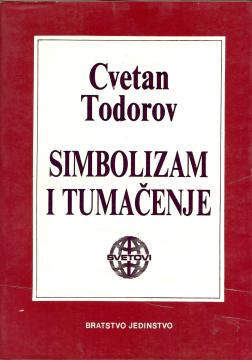
Simbolizam i tumačenje
In the book, Todorov examines the relationship between the production of discourse (rhetoric) and its interpretation (hermeneutics), focusing on verbal symbolism – the phenomenon of indirect meaning that builds on direct, literal meaning.
Symbolism only arises at the moment of interpretation: a text or discourse becomes symbolic when the reader/interpreter discovers a secondary, hidden meaning behind the primary one. A symbol is not an inherent property of the text, but the result of an interpretative act. Todorov emphasizes that symbolization and interpretation are inseparable activities – there is no symbol without interpretation, nor meaningful interpretation without recognizing the symbolic level.
The author analyzes historical approaches to symbols through two major models:
Classical (ancient and classicist) – allegorical interpretation: a sign has a hidden meaning that needs to be discovered (e.g. ancient allegory, patristic exegesis of the Bible). The goal is to find a stable, unique message behind the “veil”.
Romantic – a symbol understood as inexhaustible, ambiguous, organic; interpretation is infinite, subjective and never final (e.g. German Romanticism, Coleridge, Schelling).
Todorov shows how in the 18th–19th centuries In the 19th century, a crisis occurred between these two approaches: classical clarity and unambiguity were opposed to romantic vagueness and plurality of meanings. This tension determines modern semiotics and hermeneutics.
The book does not offer a universal definition of a symbol, but presents various historical and theoretical approaches (rhetoric, semiotics, philosophy of language, theology). It concludes that semiotics is actually symbolism, and every interpretation is always partial and conditioned by context, epoch and subject. Meaning is not fixed in either the sign or the text – it is born in the encounter between the text and the interpreter. Symbolism is therefore a dynamic process, not a static property of language.
One copy is available