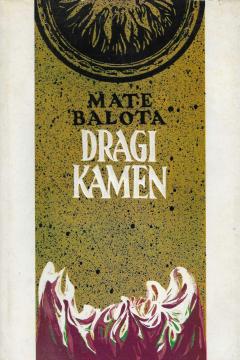
Dragi kamen
The only collection of poems by Mijo Mirković (pseudonym Mate Balota) in the Istrian Chakavian dialect – lyrics of the sea, stone, the suffering of the peasants, faith and love for Istria. The poems celebrate the sea and folk life, with a deep feeling for
Dear Stone is the only poetry collection by Mate Balota (Mija Mirković, 1898–1963), published in 1938 in Zagreb (Matica hrvatska), and later reissued several times (1947, 1972, 1988, accentuated editions in 2016 and 2023). The title comes from the poem of the same name from 1931, which symbolizes the precious, hard Istrian stone – a metaphor for the resilience, roots and beauty of one's native land.
The collection contains lyrics written in the Raklana (Istrian) Chakavian dialect – one of the most important contributions to the revival of Chakavian poetry in the 20th century. The poems are thematically divided into secular and religious motifs: love for Istria (stone, sea, olive trees, vineyards, the hard life of peasants and fishermen), social suffering (poverty, hunger, emigration), mother, faith (poems for Holy Week: Great Srida, Passion of the Lord, Good Friday, Easter Sunday), erotic and existential longing.
Balota writes simply, but deeply emotionally – he uses the vernacular, rhythm, repetitions and images from the everyday life of Istria. His poetry is not formalistic, but sincere, melancholic, sometimes pathetic, but always rooted in his homeland. Poems such as "Dear Stone", "Goat" (a social tragedy of an Istrian family), "Moja mati" or "Pramaliće" have become anthological and are often cited as examples of Chakavian lyrics.
The collection is crucial for Istrian and Croatian literature: it marked the continuity of Chakavian poetry after the 19th century (along with Mate Marjanović and others), influenced later authors (e.g. Chakavian Council, contemporary Istrian poets). Later editions often have pictorial contributions (drawings by Josip Diminić, photographs or illustrations that enhance the visual impression of the Istrian landscape – stone, sea, red soil).
The style is realistic, folk, with elements of romanticism and social lyricism – Balota, himself a hard worker, fisherman and sailor before his academic career, writes from authentic experience. Dear Stone remains a symbol of Istrian identity: "every sharp stone is dear to you" – love for a difficult but dear homeland. In Croatian literature, it is valued as the pinnacle of dialectal lyricism, with multiple reissues and musical adaptations.
One copy is available