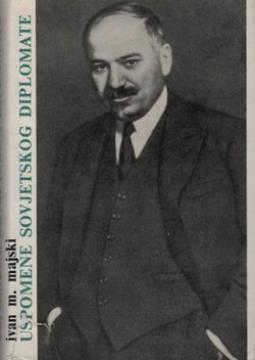
Uspomene sovjetskog diplomate

Uspomene sovjetskog diplomate

Ivan Mihajlovič Majski

Memoirs of a long-time USSR ambassador to London (1932–1943): Majski gives first-hand testimony about pre-war diplomacy, the policy of appeasement, the Ribbentrop-Molotov Pact, and war negotiations with the West.

The book Memoirs of a Soviet Diplomat by Ivan Mihajlovich Majskij (Russian: Ivan Mihajlovič Majskij, 1884–1975) is a Croatian/Serbian edition of his memoirs, focused on the key period of his life as the Soviet ambassador to Great Britain from 1932 to 1943. Majski, a former Menshevik who joined the Bolsheviks, was one of the few Soviet diplomats to hold a position in the Western world for a long time and to leave behind a detailed, personal account of the key events leading up to and during World War II.

In the center are his testimonies about the British policy of appeasement towards Hitler (Munich 1938), the negotiations on the USSR-West alliance in 1939 (which failed), the signing of the Ribbentrop-Molotov Pact, Churchill's coming to power, the German attack on the USSR in 1941 and intense discussions about the opening of a second front in Europe. Maisky describes meetings with key figures – Churchill, Eden, Halifax, Lloyd George – as well as internal Soviet dilemmas and Stalin’s instructions from Moscow.

Memoirs are written in the style of classic diplomatic memoirs: they combine official reports, personal impressions, anecdotes and political analysis, with the mild Soviet ideological tone typical of the era. They are not critical memoirs against Stalin (Maisky was later arrested in 1953, but rehabilitated), but an inside account of the Soviet perspective on the West during the crisis years. The book is a valuable historical source for understanding the dynamics of the alliance in World War II, pre-war Europe and Soviet foreign policy from the perspective of a man who was on the spot.

Original title
Воспоминания советского дипломата (1925–1945 годы)
Translation
Božidar Milosavljević
Editor
Radovan Blagojević
Dimensions
20 x 14 cm
Pages
330
Publisher
BIGZ, Beograd, 1981.
 
Latin alphabet. Hardcover with dust jacket.
Language: Serbian.

One copy is available

Condition:Used, very good condition
Damages or inconvenience notice:
  • The cover is missing
 

Are you interested in another book? You can search the offer using our search engine or browse books by category.

You may also be interested in these titles

"Enigma" do pobjede

"Enigma" do pobjede

Ilija Marinković

The story of three Polish mathematicians who cracked the German Enigma cipher machine in the 1930s. Their secret work allowed the Allies to read Nazi messages during the war, shortening it by years and saving millions of lives.

NIŠRO "Vjesnik", 1977.
Croatian. Latin alphabet. Hardcover.
6.32
The Welfare State We're in

The Welfare State We're in

James Bartholomew
Politico's Publishing, 2004.
English. Latin alphabet. Hardcover with dust jacket.
15.22
I drugi su pjevali o ratu: Odjeci raspada Jugoslavije u engleskoj i američkoj književnosti

I drugi su pjevali o ratu: Odjeci raspada Jugoslavije u engleskoj i američkoj književnosti

Muharem Bazdulj

In this book of essays, Muharem Bazdulj analyzes how the collapse of Yugoslavia and the wars of the 1990s resonated in Anglo-Saxon literature – from pre-war stereotypes to war and post-war depictions.

Biblioteka XX vek, 2013.
Croatian. Latin alphabet. Paperback.
8.24
Svjedok (ne)vremena

Svjedok (ne)vremena

Branimir Lukšić

The book is both a personal and social testimony to the turbulent times the Croatian people went through, especially during the 20th century.

Matica hrvatska, 1998.
Croatian. Latin alphabet. Paperback.
8.14
Waging War: Conflict, Culture, and Innovation in World History

Waging War: Conflict, Culture, and Innovation in World History

Wayne E. Lee
Oxford University Press, 2015.
English. Latin alphabet. Paperback.
36.22
Što je Opus Dei? Priče o Bogu, krvi, novcu i vjeri

Što je Opus Dei? Priče o Bogu, krvi, novcu i vjeri

Noam Friedlander

The Catholic movement Opus Dei, founded in 1928 in Spain as a small devout group, is today one of the most influential and richest church organizations in the world – with millions of members, a headquarters in New York worth billions, and branches across

Naklada Ljevak, 2005.
Croatian. Latin alphabet. Hardcover.
13.26