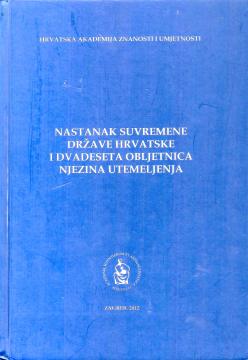
Nastanak suvremene države Hrvatske i dvadeseta obljetnica njezina utemeljenja
Rare book

Nastanak suvremene države Hrvatske i dvadeseta obljetnica njezina utemeljenja

The collection brings together presentations and speeches from two HAZU conferences on the emergence of the modern Croatian state, with an emphasis on political decisions in 1990–1991, international circumstances, and the processes of shaping Croatian sta

"The Emergence of the Modern State of Croatia" is a collection of papers, speeches, and expert analyses presented at the international scientific conference "How the State of Croatia Was Formed in 1991" and at the ceremonial session of the Croatian Academy of Sciences and Arts on the occasion of the twentieth anniversary of Croatian statehood. The introductory note highlights the context in which the conferences were held and emphasizes that the texts represent the personal views of the authors.

The first part deals with the historical and political processes that led to Croatia's independence. It includes welcoming speeches by representatives of state institutions and scientific papers that analyze key acts on sovereignty, international recognition, the role of individual states and international factors, internal political tensions, Serbian autonomous movements, and the chronology of events from 1990 to 1991. The authors also present the military, diplomatic, and geopolitical circumstances that shaped Croatia's path to independence.

The second part focuses on the ceremonial session of the Croatian Academy of Sciences and Arts in 2011, at which state officials and academics reviewed twenty years of statehood. The speeches emphasize the importance of democratic transition, national cohesion, international affirmation, and the symbolic weight of the process of creating a modern Croatian state.

The collection represents a valuable document of a historical moment and presents diverse perspectives of politicians, scholars, and participants in key events.

Editor
Davorin Rudolf, Zvonimir Baletić, Duško Bilandžić, Nikša Stančić, Petar Strčić
Dimensions
23 x 16 cm
Pages
223
Publisher
Hrvatska akademija znanosti i umjetnosti (HAZU), Zagreb, 2012.
 
Distribution: 400 copies
 
Latin alphabet. Hardcover.
Language: Croatian.

One copy is available

Condition:Unused
 

Are you interested in another book? You can search the offer using our search engine or browse books by category.

You may also be interested in these titles

Hrvatski državni arhiv

Hrvatski državni arhiv

Jozo Ivanović, Melina Lučić
Hrvatski državni arhiv, 2004.
Croatian. Latin alphabet. Paperback.
5.24
Osječka Tvrđa - Plan obnove i oživljavanja

Osječka Tvrđa - Plan obnove i oživljavanja

This book focuses on the restoration and revitalization plan of the Osijek Fortress, an important historical and architectural site in Osijek.

Urbanistički institut SR Hrvatske, 1976.
Croatian. Latin alphabet. Paperback.
36.98
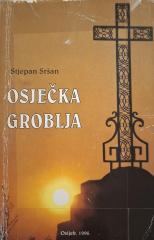
Osječka groblja

Osječka groblja

Stjepan Sršan

The book is deeply rooted in the local history and culture of Osijek, with an emphasis on cemetery motifs that serve as a metaphor for memory, death, and disappearance.

Povijesni arhiv u Osijeku, 1996.
Croatian. Latin alphabet. Paperback.
5.26
Hrvati koji su stvarali Europu

Hrvati koji su stvarali Europu

Ivan Tanta

The book collects short biographies of thirty Croatians who, through their work in various fields of science, art and society, have made a contribution to European history.

Stari grad, 2003.
Croatian. Latin alphabet. Hardcover.
6.72 - 6.82
Vojskovođa Svetozar Boroević 1856-1920.

Vojskovođa Svetozar Boroević 1856-1920.

Milan Pojić

Svetozar Boroević, the most capable Austro-Hungarian military leader of the First World War, the only Croat who received the title of field marshal and was awarded the highest Austrian decorations, has been systematically hushed up in Croatian history.

Hrvatski državni arhiv, 2006.
Croatian. Latin alphabet. Paperback.
5.46
Tumač obćemu austrijskomu gradjanskomu zakoniku I - II

Tumač obćemu austrijskomu gradjanskomu zakoniku I - II

Adolf Rušnov

The General Austrian Civil Code, published in 1811, represents the second significant codification of civil law in Europe after the famous French Code Civil from 1804. OGZ in Croatia and Slavonia was introduced in 1852, when imperial patent no. 246.

Knjižarnica Lavoslava Hartmana, 1891.
Croatian. Latin alphabet. Hardcover.
The book consists of two volumes
130.00