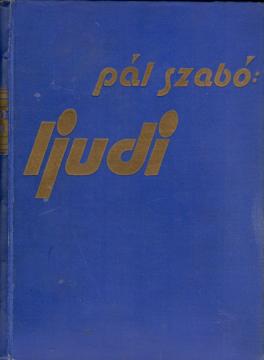
Ljudi
"People" by Pál Szab is a romanticized chronicle of a rural community in which, through everyday life, conflicts, work, and interpersonal relationships, the moral strength, weaknesses, and constant struggle of man for dignity are depicted.
People by Hungarian writer Pál Szabo is a realistic and socially penetrating novel that presents a broad picture of life in a rural community at the turn of the 19th and 20th centuries. The work focuses on ordinary people — peasants, workers, women, young and old — whose lives are marked by hard work, social inequalities, but also a strong sense of community. Szabo depicts the mentality of the rural environment in a classically realistic manner: the struggle for survival, dependence on the land, seasonal rhythms, but also the emotional tensions that arise from close, almost closed coexistence in a small community.
The novel does not have a single central character; instead, the focus is on the entire collective, where individual destinies are intertwined with social changes. In this sense, “People” functions as a kind of panorama of life: it depicts love and jealousies, family disagreements, generational differences, poverty, the pursuit of a better life, and the relationship to tradition. Szabo also highlights the moral dilemmas of the characters, exploring how external circumstances shape human nature and decisions.
The novel's particular value lies in its detailed descriptions of everyday life — from work in the fields to customs, superstitions, and the village as a social organism. The author builds a style that is both simple and poetic, wanting to emphasize that the lives of "little people" are just as worthy of literary depiction as the fates of great heroes.
People is therefore a novel about struggle, endurance, and the moral complexity of ordinary lives, a work that leaves an impression of documentary credibility and deep humanistic empathy for its characters.
One copy is available
- The cover is missing