Granica
Rare book

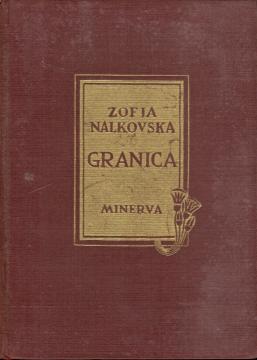
Granica

Zofia Nałkowska

Through the fate of the ambitious Zenon Ziembiewicz, the novel Granica depicts the transgression of moral, social and human boundaries – careerism, class differences and the price of compromise in interwar Polish society.

The Border (1935) is one of Zofia Nałkowska’s most significant works and the pinnacle of Polish psychological and social prose of the interwar period. The novel has a complex structure – it begins with the death of the main character Zenon Ziembiewicz, and then his life is reconstructed through retrospection.

Zenon Ziembiewicz, the son of an estate manager, is an ambitious and capable young man who quickly climbs the social ladder – from journalist to mayor. On the way to success, he crosses several “borders”: moral (betrays love and responsibility), class (exploits lower social classes) and human (loses inner purity). The story centers on two female characters: Elżbieta Biecka, a refined and cold member of the upper class, and Justyna Bogutówna, a poor, naive and emotional girl from the people whom Zenon seduces and abandons.

Nałkowska masterfully analyzes the mechanisms of careerism, the hypocrisy of bourgeois society, class divisions and moral relativity. The novel shows how an individual, in his pursuit of success and power, gradually loses the boundaries between good and evil, truth and lies, love and benefit. The criticism of patriarchal society and the fate of women in it is particularly strong.

The style is precise, psychologically deep and analytical, with elements of social satire. Nałkowska does not judge the characters directly, but rather depicts them in all their contradictions, leaving the reader to reflect on the limits of human action.

The Border is considered a classic of 20th-century Polish literature and an important testimony to the moral crisis of European civil society on the eve of World War II.

Translation
Duša Perović
Editor
Tanasije Mladenović, Risto Tošović
Illustrations
Nada Doroški
Graphics design
Stevan Vujkov
Dimensions
20 x 14 cm
Pages
306
Publisher
Minerva, Subotica, 1956.
 
Latin alphabet. Hardcover.
Language: Serbian.

One copy is available

Condition:Used, very good condition
Damages or inconvenience notice:
  • Traces of patina
 

Are you interested in another book? You can search the offer using our search engine or browse books by category.

You may also be interested in these titles

Sluga Jan

Sluga Jan

Stijn Streuvels
Nolit, 1930.
Serbian. Latin alphabet. Paperback.
37.45
Kronika o siromašnim ljubavnicima

Kronika o siromašnim ljubavnicima

Vasco Pratolini

In Florence 1925–1926, in the poor Via del Corno, the residents live in love, poverty and fear. The arrival of fascism destroys the community: lovers fight, some die from violence, but popular solidarity survives.

Sveučilišna naklada Liber (SNL), 1982.
Croatian. Latin alphabet. Hardcover with dust jacket.
3.76
Betonski vrt

Betonski vrt

Ian Mcewan
Znanje, 1984.
Croatian. Latin alphabet. Hardcover with dust jacket.
4.32
Hronika o siromašnim ljubavnicima

Hronika o siromašnim ljubavnicima

Vasco Pratolini

In Florence 1925–1926, in the poor Via del Corno, the residents live in love, poverty and fear. The arrival of fascism destroys the community: lovers fight, some die from violence, but popular solidarity survives.

Svjetlost, 1966.
Serbian. Latin alphabet. Paperback.
The book consists of two volumes
4.56
Karlo i XX. stoljeće

Karlo i XX. stoljeće

Rudolf Brunngraber

The story of Karl Lakner, caught in the huge world machine of capitalism. A political and economic visionary novel by Rudolf Brunngraber from the 1930s.

Naklada Binoza, 1939.
Croatian. Latin alphabet. Hardcover with dust jacket.
9.56 - 37.42
Španjolski vrtlar

Španjolski vrtlar

Archibald Joseph Cronin

Cronin's novel masterfully depicts the conflict between cold intellect and warmth of heart, the harmfulness of possessive love and the healing power of true human intimacy. The novel is at once a tender story about a child's soul and a sharp critique of e

Otokar Keršovani, 1966.
Croatian. Latin alphabet. Hardcover with dust jacket.
5.42