Qui judicatis
Rare book
Antique

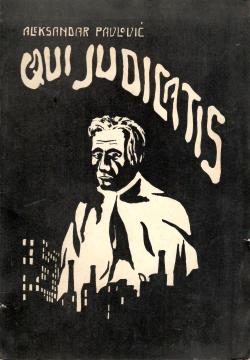
Qui judicatis

Aleksandar Pavlović

A psychological-moral novel about a representative of the so-called lost generation, the generation that came of age during World War I, faced with post-war disappointment, moral crises, and the question of justice in society.

An interwar novel that follows the life of Branko Bugarski, a young intellectual and member of the generation that grew up and matured during World War I. The work depicts the difficult adjustment of that generation in the post-war period within the new Kingdom of SHS, marked by deep disappointment in society, politics and moral values.

Through Branko's story, the author explores themes of moral crisis, social hypocrisy, justice and human responsibility. The title Qui judicatis ("You who judge") alludes to the biblical motif and the central idea of ​​the work: a critique of a civil society that condemns others, while itself is permeated with corruption, false morality and spiritual emptiness. The novel contains psychological analyses of the main character's internal conflicts, his love drama, professional frustrations and the search for meaning and authentic values ​​in a chaotic post-war world.

The style is serious, introspective and reflective, with touches of social satire and moralism. The book presents an interesting, albeit little-known, testimony to the generational trauma and disappointment of the young Croatian intelligentsia of the 1920s. The edition features a cover by graphic artist P. Klarić.

Translation
P. Klarić
Dimensions
21 x 15 cm
Pages
103
Publisher
Novinska štamparija S. Pintarić, Zagreb, 1927.
 
Latin alphabet. Paperback.
Language: Croatian.

One copy is available

Condition:Used, excellent condition
 

Are you interested in another book? You can search the offer using our search engine or browse books by category.

You may also be interested in these titles

Kako sam ubila svoje dijete

Kako sam ubila svoje dijete

Pierre L'ermite

A moralistic novel written in the form of a confession in which a young woman tells how she had an abortion out of vanity, fear of scandal, and frivolity, and then experiences deep remorse, suffering, and spiritual conversion.

Knjižnica dobrih romana, 1929.
Croatian. Latin alphabet. Hardcover.
9.56
​Mladost Njegoševa

​Mladost Njegoševa

Jovan Angelus

"The Youth of Njegoš" by Jovan Angelus is a biographical narrative depicting the early years of the life of Petar II Petrović Njegoš, one of the most important Montenegrin rulers, poets and philosophers.

Jugoreklam, 1982.
Croatian. Latin alphabet. Hardcover.
6.78
Čudovište iz predgrađa

Čudovište iz predgrađa

Franz Herwig

The novel The Monster from the Suburbs, published in 1936 by the Spiritual Youth Association in Senj, is a contemporary legend that explores the psychological and social aspects of life in urban suburbs.

Zbor duhovne mladeži, 1936.
Croatian. Latin alphabet. Paperback.
7.56
Proljetne oluje: knjiga za mužku omladinu

Proljetne oluje: knjiga za mužku omladinu

Tihomir Toth

A Catholic spiritual book for young men about the turbulent spring storms of youth, dealing with inner temptations, building character, and spiritual maturation in difficult times of war. A warm and encouraging message to young men.

Zbor duhovne mladeži, 1943.
Croatian. Latin alphabet. Paperback with dust jacket.
9.48
Cvijeće sreće moraš saditi sam

Cvijeće sreće moraš saditi sam

Phil Bosmans

Poetic fragments of a Belgian priest who, with the power of spiritual authority, spread the influence of his interesting movement (Union without names) all over the world.

Kršćanska sadašnjost, 1999.
Croatian. Latin alphabet. Hardcover.
9.38
Mirisni vrt šeika Nefzavija

Mirisni vrt šeika Nefzavija

Muḥammad Ibn Muḥammad Al-Nafzawī

A classic 15th-century erotic manual, written by Sheikh Nefzawi at the request of the Sultan of Tunisia. Similar to the Hindu Kama Sutra, it presents an Islamic view of sexuality within marriage, emphasizing harmony and pleasure for partners.

SKD Prosvjeta, 1972.
Croatian. Latin alphabet. Paperback.
7.325.86