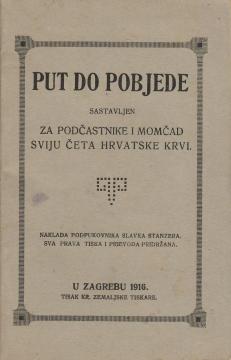
Put do pobjede - sastavljen za podčastnike i momčad sviju četa hrvatske krvi
Military propaganda brochure intended for Croatian Home Guards in World War I. A combination of combat instructions, moral encouragement and national appeal. Extremely rare.
Slavko Štancer (Stanzer) (1872–1945), Austro-Hungarian lieutenant colonel (later general of the Croatian Armed Forces), commander of the auxiliary battalion of the 25th Zagreb Home Guard Regiment, published this small booklet in 1916 in his own press in Zagreb (printed by the Kr. Zemljak printing house). The booklet is intended for non-commissioned officers and ordinary soldiers of "Croatian blood" on the battlefield.
The work is a combination of practical combat instructions and motivational and propaganda text. The author seeks to raise the morale of Croatian soldiers, encourage discipline, courage and loyalty, and bring them closer to the meaning of their sacrifice by emphasizing Croatian national identity within the Austro-Hungarian army. The text was written with the aim of influencing Croatian recruits and soldiers on the Serbian and Russian battlefields.
This brochure has a significant place in the study of Croatian participation in World War I because it is one of the rare military propaganda publications that directly addresses Croatian soldiers in their language and with an emphasis on their national pride. It is believed that it was probably written by Štancer himself. There is also a second, revised edition from 1917 entitled The Road to Victory Compiled for Croatian Soldiers.
The original edition from 1916 is extremely rare. Today it is available mainly in digital collections (e.g. Digital NSK) and in the form of reprints (Fortuna, Strmec Samoborski). Due to its small circulation, wartime nature and the deterioration of copies, it is considered a true bibliographic rarity among materials from World War I.
The brochure is an important source for the study of Croatian war propaganda, national awakening within the Austro-Hungarian army and the activities of Home Guard officers. It testifies to an attempt to strengthen Croatian identity among soldiers at a time when the Monarchy was still trying to maintain loyalty. Later, Štancer became one of the leading officers of the NDH, which further connects this brochure to his turbulent biography.
One copy is available