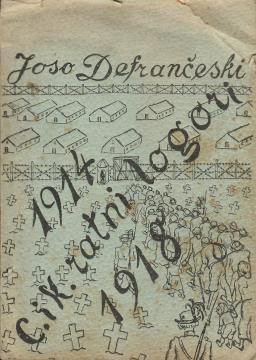
C. i Kr. ratni logori 1914.–1918.
Antique
Rare book

C. i Kr. ratni logori 1914.–1918.

Joso Defrančeski

The first comprehensive account of the suffering of Istrian civilians (mostly women, children and the elderly) in Austro-Hungarian refugee camps during World War I, based on the personal memories of the author from Ližnjan.

Josip (Jose) Defrančeski's book *C. and Kr. war camps 1914–1918. is one of the most important testimonies about the humanitarian catastrophe that befell the population of Southern Istria after Italy entered the war in 1915. The Austro-Hungarian authorities evacuated (or expelled) tens of thousands of civilians — mostly Croats from the Pula and Ližnjan areas — to camps and settlements in Hungary, Moravia, the Czech Republic and Austria. The worst was in the large refugee camp Gmünd in Lower Austria, where thousands died of hunger, typhus, dysentery and other diseases due to catastrophic conditions.

The author Joso Defrančeski (Ližnjan, 1906 – Argentina, mid-1970s) wrote the book based on his own traumatic childhood experience. As a nine-year-old, he was expelled from Ližnjan with his mother, brothers, grandmother and grandfather. In the Gmünd camp, he lost his younger brother Ivica and his grandfather. The book is therefore at the same time a personal memoir and a broader historical documentation of the fate of the Istrian "evacuees". Defrančeski emphasizes that he did not exaggerate anything, but even toned down a lot.

The book represents the first comprehensive presentation of this topic in Croatian (Yugoslav) literature. It later saw an expanded edition (Ližnjan, 2015). The style is direct, emotional and documentary, with many specific names, places and destinies. The book is not only an accusation against the Austro-Hungarian authorities for negligence and inhumane treatment, but also a valuable source for studying the First World War "in the background", the Italianization of Istria and the fate of the Istrian Croats.

Today it is considered a bibliographical rarity. Copies of the first edition from 1937 appear very rarely on the market and are sought after among collectors of Istrian themes, literature about the First World War, and regional history.

Dimensions
20 x 14 cm
Pages
200
Publisher
Štamparija Antun Rott, Osijek, 1937.
 
Latin alphabet. Paperback.
Language: Croatian.

One copy is available

Condition:Used, very good condition
Damages or inconvenience notice:
  • Traces of patina
  • Slight damage to the cover
 

Are you interested in another book? You can search the offer using our search engine or browse books by category.

You may also be interested in these titles

Dan kada je nastala država Hrvatska 1991.

Dan kada je nastala država Hrvatska 1991.

Davorin Rudolf, Vladimir Šeks, Jasna Omejec

The collection brings together scholarly works on key political, legal, and diplomatic processes that led to the creation of the Croatian state in 1991, analyzing the decisions, actors, and international circumstances crucial to independence.

Hrvatska akademija znanosti i umjetnosti (HAZU), 2015.
Croatian. Latin alphabet. Paperback.
17.26
Sjećanja na slavne Hrvate

Sjećanja na slavne Hrvate

Draga Ungaro
Tonimir, 1997.
Croatian. Latin alphabet. Hardcover.
9.767.81
Povijest i kultura Hrvata kroz 1000 godina: Od velikih seoba do XVIII. stoljeća

Povijest i kultura Hrvata kroz 1000 godina: Od velikih seoba do XVIII. stoljeća

Horvat
Josip Horvat

One of the most prominent Croatian cultural historians, Josip Horvat, in one of his best texts, not only describes the cultural achievements of Croats, but also analyzes them on the basis of political, social and other events that Croatian history is full

Knjigotisak d. o. o., 2009.
Croatian. Latin alphabet. Hardcover.
12.209.15
U modi: Kultura odijevanja porečkih plemenitih građana (1650.-1720.)

U modi: Kultura odijevanja porečkih plemenitih građana (1650.-1720.)

Elena Uljančić

The book represents a novelty not only in Istrian, but also in Croatian historiography. Namely, the clothing culture in the region of Istria in the early modern period has not yet been analyzed at all, and for the region of Dalmatia only sporadically.

Srednja Europa, 2019.
Croatian. Latin alphabet. Hardcover.
16.99
Nastanak suvremene države Hrvatske i dvadeseta obljetnica njezina utemeljenja

Nastanak suvremene države Hrvatske i dvadeseta obljetnica njezina utemeljenja

The collection brings together presentations and speeches from two HAZU conferences on the emergence of the modern Croatian state, with an emphasis on political decisions in 1990–1991, international circumstances, and the processes of shaping Croatian sta

Hrvatska akademija znanosti i umjetnosti (HAZU), 2012.
Croatian. Latin alphabet. Hardcover.
17.26
Na vratima Požeške doline

Na vratima Požeške doline

Dragutin Pavličević

A classic of local historiography, it depicts the history, geography and culture of the Požega Valley from prehistoric times to the modern era. The work describes the region's strategic position, the influences of the Romans, Ottomans and Habsburgs, with

Matica hrvatska, 1961.
Croatian. Latin alphabet. Paperback.
12.36