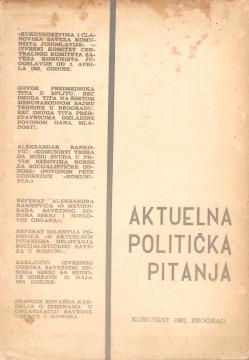
Aktuelna politička pitanja 1962.
Current Political Issues records the moment when the top of the Communist Party of Yugoslavia in 1962 publicly acknowledged the difficulties of reform: in Tito's speech in Split and Ranković's contributions, one sees the crisis, discipline, and struggle o
The bulletin Current Political Issues from 1962 is valuable above all as a condensed document of the party moment. The very choice of texts shows what the top of the Communist Party of Yugoslavia considered urgent: the situation in the Party, the activities of the Socialist Federal Republic of Yugoslavia, socialist relations, political discipline and the role of communists in the period of reform tensions. The main articles on the cover were Tito's speech in Split, Ranković's report, and the presentations of Milenti Popović and Edvard Kardelj, which shows that the issues of political leadership, social relations and organizational control were in the foreground.
Tito's speech in Split is particularly important because it no longer has the self-confident tone of earlier years, but rather an open warning that the development of socialism is not going as expected. At the heart of it are criticism of the communists, weaknesses in governance, the emergence of privileges, inequality and social stratification, and the danger of political responsibility being diluted. This is precisely why that speech acts as an early public sign of the reform crisis: Tito does not reject the reforms, but makes it clear that their effects produce disturbances that the Party can no longer conceal.
Ranković's contributions in the same newsletter are important because they show a different emphasis: less on social self-criticism, and more on work methods, organization, the presence of communists "in the front ranks" and strengthening of the political center. It can be seen from the headlines that Ranković sees the problem primarily as a question of political mobilization, discipline and efficiency of party and socio-political bodies. That is why Tito's speech and Ranković's paper in this issue can be read as two responses to the same crisis: one emphasizes the symptoms of deformation in society, and the other the need for stronger political and organizational intervention from above.
That is why the newsletter is not only a collection of speeches, but also a trace of an internal fracture. It does not yet contain the open fracture that will culminate a few years later, but it clearly shows the terrain on which the conflict will develop: how to reform Yugoslavia, how much space to give to decentralization, and how much to give to political unity and supervision. In this sense, this edition of Current Political Issues acts as an early document of the crisis that will later lead to the Brijuni Plenum and a new constitutional reorganization of the Yugoslav federation.
One copy is available