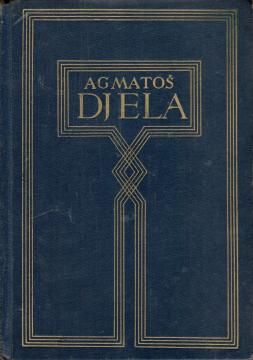
Djela 5: Pjesme i epigrami
The fifth volume of Barč's edition of Matoš's collected works contains his lyrics and epigrams, symbolist-romantic verses with themes of love, death, homeland, melancholy and irony, mostly published posthumously.
The book Works 5: Poems and Epigrams is the fifth volume in the 17-volume critical edition of Works by A. G. Matoš (1935–1940). Like the previous volumes, the literary legacy was collected by Matoš's brother Milan Matoš, and Antun Barac edited the texts in a philological way, with notes on genesis, variants and previous (often magazine) publications. This is one of the first more systematic collected editions of Matoš's poetry, which during the author's lifetime remained scattered in magazines and partially unpublished.
Matoš wrote poetry in parallel with prose and essays, but published it sporadically. The collection Poems and Epigrams gathers his lyrics — from early romantic and symbolist verses to later, melancholic and polemical epigrams. The key themes are love (often unhappy, idealized), death, transience, patriotism (songs such as the cycle about Croatia, "1909," etc.), nature (nocturne, autumn motifs), and irony and satire aimed at contemporaries. The style is refined, musical, with rich symbolism, allusions to the European tradition (Baudelaire, Poe, French symbolists) and Matoš's distinctive language expression — a combination of lyricism and intellectual sharpness.
Epigrams bring witty, often caustic short forms with which Matoš polemicized with literary and political opponents, showing his polemical spirit and mastery of concise expression. The poetry reflects Matoš's bohemian life, existential sadness, nostalgia for lost ideals and the deep sense of loneliness of a modern artist. Many songs have an autobiographical tone (impressions from Paris, Belgrade, Zagreb), and some (eg nocturna, "Autumn evening", "Notturno") are among the highlights of Croatian modern lyricism.
In the context of Barč's entire publication, the fifth volume completes the image of Matoš as a versatile writer: after prose, essays and travelogues comes poetry, which shows his sensitivity and aesthetic refinement. Barč's edition from 1937 had great significance because it made Matoš's poetry available on a larger scale before later, more complete editions (eg JAZU's).
Today, Matoš's lyrics are appreciated as a bridge between Croatian romanticism and modernity, with a strong influence of European currents. Epigrams bear witness to his combativeness and wit. This book is indispensable for understanding Matoš's worldview — cosmopolitan, patriotic, decadent and vital at the same time — and his permanent place in the canon of Croatian literature as one of the greatest stylists and innovators.
One copy is available