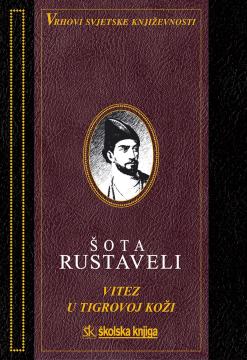
Vitez u tigrovoj koži

Vitez u tigrovoj koži

Šota Rustaveli

Shota Rustaveli, the author of the famous song The Knight in the Tiger's Skin (Vepxistqaosani), is called the "Georgian Homer" precisely because of this masterpiece, which belongs to the pinnacle of world literature.

His song about friendship and love was published for the first time in the Croatian language, thanks to the masterful virtuosity of the translator and poet Luka Paljetek.

Little is known about the life of the Georgian poet Shota Rustaveli (around 1160 - after 1210). According to one legend, he was exiled to the monastery of the Holy Cross in Jerusalem because of his hopeless love for Empress Tamara. According to another, he was exiled because he did not respond to the empress's love offers.

Be that as it may, Rustaveli definitely ended up in exile. Namely, in 1870 it was recorded that Rustaveli's grave and his portrait on the wall of the temple were found in Jerusalem in the endowment of the Georgian emperors, in the Church of the Holy Cross. On it, the aged poet is depicted in the garb of a Georgian feudal lord.

Original title
Vephistkaosani
Translation
Luko Paljetak
Editor
Miroslava Vučić
Dimensions
25 x 20 cm
Pages
312
Publisher
Školska knjiga, Zagreb, 2016.
 
Distribution: 500 copies
 
Latin alphabet. Hardcover.
Language: Croatian.
ISBN
978-9-53061-661-5

No copies available

The last copy was sold recently.

 

Are you interested in another book? You can search the offer using our search engine or browse books by category.

You may also be interested in these titles

Znamenovanje ruske revolucije

Znamenovanje ruske revolucije

Lav N. Tolstoj

Tolstoy interprets the 1905 revolution as a moral upheaval: violence does not bring justice, but a new yoke. He sees lasting liberation in personal conscience, non-violence and Christian love, not in the state and coercion.

St. Kugli, 1907.
Croatian. Latin alphabet. Hardcover.
17.24
Zapisi iz mrtvog doma / Zimske bilješke o ljetnim dojmovima / Zapisi iz podzemlja

Zapisi iz mrtvog doma / Zimske bilješke o ljetnim dojmovima / Zapisi iz podzemlja

Fjodor M. Dostojevski

Notes from a Dead Home (1860-1862) - a novel based on the author's imprisonment in Siberia. Winter Notes on Summer Impressions (1863) - an essay from a trip to Europe in 1862. Notes from the Underworld (1864) is a philosophical novel about a man torn by i

Jutarnji list, 2005.
Croatian. Latin alphabet. Paperback.
11.76
Admiral Senjavin (1763–1831)

Admiral Senjavin (1763–1831)

Vladimir L. Snjegirjov

A popular biography of the famous Russian admiral Dmitry Senyavin, part of the Maritime and Shipping Library edition. The work is intended for a wider audience, especially younger readers and lovers of maritime history.

Tehnička knjiga, 1949.
Serbian. Latin alphabet. Paperback.
9.42
Bijedni ljudi

Bijedni ljudi

Fjodor M. Dostojevski

Poor Folk is the first novel by Fyodor M. Dostoevsky. Through the letters of the poor clerk Makar Devushkin and Varvara Dobroselova, it depicts the lives of people on the margins of society, their loneliness, poverty, and struggle to preserve their dignit

Narodna knjižnica, 1919.
Croatian. Latin alphabet. Paperback.
5.24
Svjetska knjižnica, Sv. 3.

Svjetska knjižnica, Sv. 3.

Fjodor M. Dostojevski, Henryk Sienkiewicz

The World Library, Volume 3, edited and published by Iso Velikanović, contains excerpts from The Brothers Karamazov by F. M. Dostoevsky and Without Dogma by H. Sienkiewicz. Designed for self-binding of individual works.

Vlastita naklada, 1903.
Croatian. Latin alphabet. Paperback.
17.24
Vojnici se ne rađaju 1-2

Vojnici se ne rađaju 1-2

Konstantin Simonov

The novel "Soldiers Are Not Born" by Konstantin Simonov depicts the Red Army's battles on the Stalingrad battlefield and follows soldiers and commanders who mature through the trials of war and become true warriors.

Naprijed, 1966.
Croatian. Latin alphabet. Hardcover with dust jacket.
The book consists of two volumes
16.42