Ptice

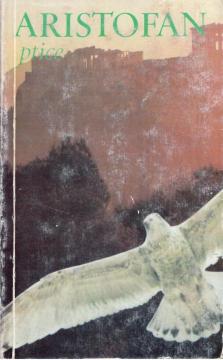
Ptice

Aristofan

Aristophanes' most fantastic comedy. Two Athenians, out of boredom, persuade birds to build a new city in the clouds – Nephelokokygia (Cloudcuckoo City). The dream of an ideal society turns into a daring utopia and a parody of power.

The Birds (414 BC) is one of the most poetic and imaginative comedies by Aristophanes. It is considered a masterpiece of old Attic comedy and is often ranked among his best works.

The plot follows two Athenians, Pistetaerus (Peisetaerus) and Euelpidus, who flee Athens, fed up with trials, taxes, and war. In the forest, they meet a nightingale bird (former king Tereus) and decide to found a new city between heaven and earth – Nephelocokygia (Cloudcuckoo City). They persuade the birds to join them, declare themselves the rulers of the birds, and block the gods from accessing earthly sacrifices.

Through a fantastic plot, Aristophanes masterfully parodies Athenian politics, religion, utopian dreams, and the human desire for power. Pistetaerus eventually turns into a tyrant who marries the goddess Basilea and becomes the new ruler of the universe. The comedy ends with the celebration and triumph of the new order.

Birds stand out for their beautiful, lyrical choruses of birds, rich poetic language and imagination. Along with Lysistrata and The Frogs, this is Aristophanes' most performed comedy. The work contains a deep satire on Athena, but also a universal message about human ambition, utopia and power.

Critics often interpret it as an escapist fantasy at the time of the Sicilian expedition (war defeat of Athens), but also as an ingenious vision of a new, ideal city. The Birds is a witty, poetic and topical critique of human nature – a masterpiece of ancient comedy that still fascinates today with its imagination and wit.

Original title
Ὄρνιθες
Translation
Mladen Škiljan
Dimensions
20 x 14 cm
Pages
468
Publisher
VPA, Zagreb, 1988.
 
Latin alphabet. Paperback.
Language: Croatian.

One copy is available

Condition:Used, very good condition
Damages or inconvenience notice:
  • Worn covers
 

Are you interested in another book? You can search the offer using our search engine or browse books by category.

You may also be interested in these titles

Žabe

Žabe

Aristofan

A comedy in which the god Dionysus descends into the underworld to bring the best tragedian back to Athens. Aeschylus and Euripides clash in an underground competition, and the comedy humorously discusses the fate of tragedy, art, and Athenian society in

Matica srpska, 1987.
Serbian. Cyrillic alphabet. Hardcover with dust jacket.
7.99 - 8.52
Kako što nastaje: novine, film, teatar

Kako što nastaje: novine, film, teatar

Karel Čapek

In a witty and instructive essay, Čapek describes how a newspaper, a film, and a theater play are created. Through humor and irony, he shows the complexity of the process – from idea to realization – and the different perspectives of the participants, dem

Znanje, 1985.
Croatian. Latin alphabet. Paperback.
4.76
Sophocles' Tragic World: Divinity, Nature, Society

Sophocles' Tragic World: Divinity, Nature, Society

Charles Segal
Harvard University Press, 1998.
English. Latin alphabet. Paperback.
13.12
Od rituala do medija: mađarska drama na prijelazu tisućljeća

Od rituala do medija: mađarska drama na prijelazu tisućljeća

Peter P. Müller

System change in Hungary in 1989/90. did not change the theater structure, although the publishing structure was significantly transformed.

Matica hrvatska, 2009.
Croatian. Latin alphabet. Paperback.
6.24
Sineast # 86/87

Sineast # 86/87

Kino savez Bosne i Hercegovine, 1990.
Croatian. Latin alphabet. Paperback.
2.99
Govorna interpretacija umjetničkoga teksta

Govorna interpretacija umjetničkoga teksta

Novak Novaković

The spoken interpretation of an artistic text arises from the individual's desire to verbally shape the text of an artistic character in an artistic way as his own experience. This handbook of interpretive reading and recitation will help with that.

Školska knjiga, 1980.
Croatian. Latin alphabet. Hardcover.
6.62