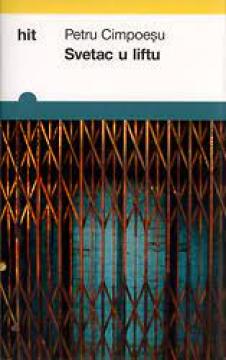
Svetac u liftu: Roman s anđelima i Moldavcima

Svetac u liftu: Roman s anđelima i Moldavcima

Petru Cimpoesu

The Saint in the Elevator by Petru Cimpoeşu is a satirical novel about the residents of a Romanian skyscraper who are disturbed by a rumor that a saint has appeared in the elevator. A seemingly ordinary event grows into a social phenomenon.

The Saint in the Elevator is a novel by Romanian writer Petru Cimpoeșu that depicts life in post-socialist Romania through humor, irony, and elements of the absurd. The plot is set in an apartment building in a provincial town, where a story begins to circulate among the residents that a saint has appeared in an elevator.

The alleged apparition provokes different reactions. Some residents accept the event as a miracle and a sign of divine presence, others remain skeptical, and still others try to use the situation for personal gain. Through their conversations, conflicts, and speculations, the author builds a mosaic of different destinies and mentalities.

The novel does not have a single main character. The center is on the numerous residents of the building: retirees, workers, small entrepreneurs, former party cadres, religious people, and opportunists. Each of them interprets the miracle according to their own interests, fears, and beliefs. As the rumor grows, the ordinary elevator becomes a place of pilgrimage, media attention, and social controversy.

Beneath the humorous surface lies a critique of a society that, after the fall of communism, is looking for new values and authorities. Cimpoeşu shows how religion, politics, the media and everyday interests easily intertwine and how people often believe rumors more than facts.

The Saint in the Elevator is at once a satire, a social novel and an allegory about the need for faith and meaning. Through a seemingly banal situation, the author depicts the confusion, hopes and contradictions of Romanian society at the transition to a new era.

Original title
Simion liftnicul
Translation
Mate Maras
Editor
Tomislav Zagoda
Dimensions
20 x 12 cm
Pages
347
Publisher
Znanje, Zagreb, 2009.
 
Latin alphabet. Hardcover with dust jacket.
Language: Croatian.

One copy is available

Condition:Used, excellent condition
Discounted price: 8.506.80
20% discount is valid until 6/6/26 11:59 pm
 

Are you interested in another book? You can search the offer using our search engine or browse books by category.

You may also be interested in these titles

Nekoć kad smo bili odrasli

Nekoć kad smo bili odrasli

Anne Tyler

Once Upon a Time When We Were Grown Ups by Anne Tyler follows Rebecca Davitch, a woman who, in middle age, begins to wonder whether her life took the path she chose or whether it was shaped by a combination of circumstances.

Znanje, 2004.
Croatian. Latin alphabet. Paperback.
3.98
Ljubavlju opsjednuti

Ljubavlju opsjednuti

Terje Stigen

Obsessed with Love by Terje Stigen is a novel about a love affair that gradually turns into an obsession. Through conflicts, jealousy, and emotional dependence, it depicts the destructive power of uncontrolled passion.

Znanje, 1975.
Croatian. Latin alphabet. Hardcover with dust jacket.
3.98
Karanova sofa

Karanova sofa

Pero Budak

A saga about the rise and fall of the Karan family from Lika from the mid-19th century to the present day. The novel follows several generations of the family, intertwining their fates with historical and social upheavals, including wars, migrations, and

Znanje, 1990.
Croatian. Latin alphabet. Hardcover with dust jacket.
4.74
Dok vrijeme prolazi

Dok vrijeme prolazi

Michael Walsch

Michael Walsh's As Time Goes By continues and expands the story of the film Casablanca, following the fates of Rick, Ilsa and other characters during World War II through love, war and dangerous missions.

Znanje, 1999.
Croatian. Latin alphabet. Paperback.
4.36
Carstvo sunca

Carstvo sunca

J. G. Ballard

Empire of the Sun by J. G. Ballard is a war novel about a boy who survives the horrors of war during the Japanese occupation of China. The work depicts the loss of innocence, resilience, and the strength of the human spirit.

Znanje, 1987.
Croatian. Latin alphabet. Hardcover with dust jacket.
8.125.68 - 8.12
Krasopis

Krasopis

Pavao Pavličić

What happens when the writer himself is the protagonist of his novel and writes it in the first person? The answer to this question can be obtained by reading the novel "Krasopis".

Znanje, 1987.
Croatian. Latin alphabet. Hardcover with dust jacket.
4.36 - 4.42