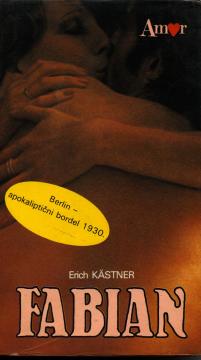
Fabian: Pripovijest o moralistu

Fabian: Pripovijest o moralistu

Erich Kästner

Jakob Fabian, an unemployed Germanist and moralist, wanders through Berlin in the 1930s, observing the moral, political and social decay and the rise of Nazism. He falls in love with Cornelia, but tragedies and nonsense lead him to a tragic end. Criticism

The novel by Erich Kästner (1899–1974), author of children's classics such as Emil and the Detective and The Flying Class, Fabian is his most serious, darkest and most political work for adults. Published in 1931 in Stuttgart, the novel was immediately banned and burned by the Nazis in 1933 (Kästner was present at the burning of his own books). The first edition was censored (explicit erotic parts were removed); the full, uncensored version (Der Gang vor die Hunde) was only published posthumously in 2013, and earlier in some editions.

The protagonist Jakob Fabian (32 years old, doctor of German) works in an advertising agency, but loses his job in the midst of the economic crisis. A passive observer ("just watching"), he drifts through Berlin's nightlife: cabarets, brothels, alcohol, superficial relationships, political extremes (communists vs. Nazis). Fabian is an intellectual-moralist who believes in reason, decency and humanism, but he sees society falling apart - people are sold, values ​​disappear, politics becomes a circus. He falls in love with Cornelia Battenberg, an ambitious actress and intellectual, who gives him hope, but the relationship falls apart under the pressure of time. The key tragic event: the suicide of a friend of Labude (due to a false accusation of plagiarism), which Fabian perceives as a personal defeat. In the end, in a drunken state, Fabian drowns in the river – a senseless, helpless ending that symbolizes the fate of the liberal intelligentsia in the face of totalitarianism.

The novel is a mixture of satire, melancholy and sharp social criticism: it makes fun of the Berlin decadence of the "golden twenties" that turns into a nightmare, pornography as a metaphor for society, media manipulation, mass unemployment. Kästner uses short, crisp sentences, a documentary style, newspaper quotes and poems.

Naslov izvornika
Fabian. Die Geschichte eines Moralisten
Prijevod
Stanislav Šimić
Urednik
Milan Mirić
Dimenzije
20,5 x 12,5 cm
Broj strana
200
Nakladnik
Naprijed, Zagreb, 1986.
 
Tiraž: 10.000 primjeraka
 
Latinica. Tvrde korice s ovitkom.
Jezik: Hrvatski.
ISBN
8-63-490044-4

Nema primjeraka u ponudi

Poslednji primjerak je nedavno prodan.
 

Zanima Vas i neka druga knjiga? Možete pretražiti našu ponudu pomoću tražilice ili prelistati knjige po kategorijama.

Možda će Vas zanimati i ovi naslovi

Blizanke

Blizanke

Erich Kästner
Mladost, 1969.
Hrvatski. Latinica. Broširano.
1,95
Čovječuljak

Čovječuljak

Erich Kästner
Mladost, 1976.
Hrvatski. Latinica. Tvrde korice.
3,98 - 4,98
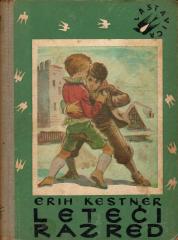
Leteći razred

Leteći razred

Erich Kästner

Many people throw away their childhood like old hat. They forget it like a phone number that no longer works. First such people were children, then they became adults, but what are they really? Only those who grow up and remain human!

Narodna prosvjeta, 1959.
Hrvatski. Latinica. Tvrde korice.
6,78
Noć

Noć

Edgar Hilsenrath

A poignant novel describing life in a Jewish ghetto in Ukraine, based on the author's experience as a Holocaust survivor. Set in the fictional town of Prokov, the novel follows the inhabitants of the ghetto, especially Raneko, as they struggle to survive.

August Cesarec, 1982.
Hrvatski. Latinica. Tvrde korice s ovitkom.
6,58
Posljednji harem

Posljednji harem

Peter Prange

If you love One Thousand and One Nights with a historical twist, this is a sensual harem saga – rich, emotional, irresistible! An epic novel about the end of the Ottoman Empire, harem intrigue, and the birth of modern Turkey.

Naklada Ljevak, 2010.
Hrvatski. Latinica. Broširano.
11,26
Olfi među ženama

Olfi među ženama

Christine Nöstlinger

The novel humorously and warmly depicts the everyday life of a fourteen-year-old boy, Olfi (Wolfgang), the only man in a house full of women. A classic of Austrian children's literature, it is often read in elementary school.

Znanje, 2009.
Hrvatski. Latinica. Broširano.
9,76 - 9,78