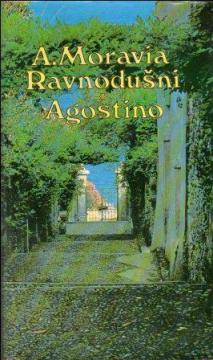
Ravnodušni / Agostino

Ravnodušni / Agostino
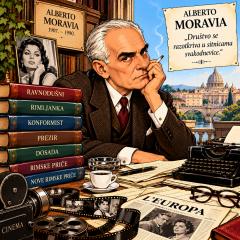
Alberto Moravia

Indifferent (1929), Moravia's first and most famous novel, a masterpiece of Italian modernism, the novel that brought him fame and recognition. Agostino (1944) is one of Moravia's most lyrical prose works, a short but powerful novel about coming of age.

“Indifferent”: Rome, late 1920s. The Ardengo family – widow Mariagrazia, son Michele (24) and daughter Carla (20) – live under a false bourgeois facade while their house literally collapses due to debts. Leo Merumeci, the mother’s rich and cynical lover, offers “salvation”: money for a villa in exchange for Carla’s body. Michele, an intellectual full of contempt for the world, realizes that he himself is indifferent – ​​he hates Leo, but cannot act. In 48 hours everything collapses: Carla agrees to a compromise, Michele misses the opportunity for revenge, the mother remains blind. The novel is a cold, surgically precise analysis of moral decay, hypocrisy and powerlessness in the face of evil. A work that shocked fascist Italy because it showed that indifference is not innocence, but complicity.

“Agostino”: Thirteen-year-old Agostino spends his summers with his widowed mother on the seaside. The ordinary relationship between mother and son is shattered when the boy discovers that his mother has a lover and that she is a woman in front of other men. He begins to be obsessed with sexuality, class differences and his own powerlessness. He joins a gang of poor beach boys who introduce him to a world of rudeness, prostitution and ridicule. In an attempt to “become a man”, Agostino goes through humiliations and realizes that adulthood is not heroic, but a painful and dirty thing. The mother remains an unattainable object, and the boy returns home wounded and a stranger in his own body.

Both novels explore the loss of innocence – social in “The Indifferent”, personal in “Agostino” – and remain the culmination of Moravia’s obsession with alienation, sex and the hypocrisy of the bourgeoisie.

Original title
Gli indifferenti
Translation
Zlatka Ružić
Editor
Milan Mirić
Dimensions
21.5 x 13 cm
Pages
392
Publisher
Novi Liber, Zagreb, 1982.
 
Latin alphabet. Hardcover with dust jacket.
Language: Croatian.

One copy is available

Condition:Used, excellent condition
 

Are you interested in another book? You can search the offer using our search engine or browse books by category.

You may also be interested in these titles

Čovek koji gleda

Čovek koji gleda

Alberto Moravia
Minerva, 1988.
Serbian. Latin alphabet. Hardcover with dust jacket.
6.63
Automat

Automat

Alberto Moravia
Otokar Keršovani, 1966.
Croatian. Latin alphabet. Hardcover.
3.99
Pažnja

Pažnja

Alberto Moravia
Otokar Keršovani, 1966.
Croatian. Latin alphabet. Hardcover.
3.99
Stotina godina (antikronika)

Stotina godina (antikronika)

Dario Harjaček

Der Roman „Hundert Jahre“ von Dario Harjaček bietet einen Panoramablick auf Trešnjevka und seine Bewohner im Laufe eines Jahrhunderts voller Veränderungen, Ideologien und menschlicher Schicksale – ein Mosaik von Zagreb, in dem Leben, Kunst und Geschichte

Oceanmore, 2025.
Croatian. Latin alphabet. Paperback.
13.42
Proces

Proces

Franz Kafka

Kafka je napisao „Proces“ između 1914. i 1915. godine, objavljen posthumno 1925. godine. Roman je nedovršen, ali sa dodatnim završnim poglavljem koje je napisao Maks Brod. Izdanje sa predgovorom B. Živojinovića i pogovorom Valtera Kilija.

BIGZ, 1990.
Serbian. Latin alphabet. Paperback.
4.26
Andrićeva lestvica užasa

Andrićeva lestvica užasa

Svetislav Basara

A Serbian writer known for his satirical novels, Andrić's Ladder of Horrors dissects the Balkan mentality through a parable of Yugo-nostalgia and national myths. The title alludes to Ivo Andrić as a litmus test for criticism – Balkans claim him or reject

24 sata, 2021.
Serbian. Latin alphabet. Paperback.
11.56