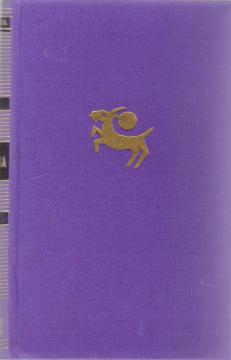
Rimske priče: izbor
Collections of short stories from Roman life in the post-war era: ordinary people from the people and the petty bourgeoisie – the poor, workers, small craftsmen – face misery, survival, jealousy, petty deceit and moral compromises in everyday life.
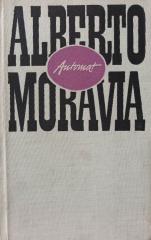
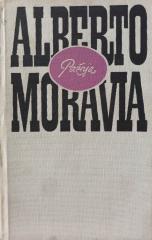
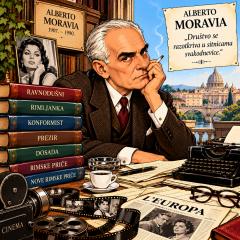
Roman Stories is a selection of the most representative stories from two collections by Alberto Moravia: Racconti romani (1954) and Nuovi racconti romani (1959), a total of over 130 short stories written mainly between 1948 and 1959, first published in newspapers (Corriere della Sera, La lettura). These stories mark Moravia's neorealist turn after The Roman Woman (1947) – a focus on post-war Rome, in transition from misery and ruins to economic prosperity (miracolo economico).
The main characters are the "little people" of Rome: the proletariat, the lumpenproletariat, the petty bourgeoisie – taxi drivers, workers, shopkeepers, housewives, petty thieves, the unemployed, young people from the periphery. The stories are almost always in the first person, with an emphasis on colloquial language, Roman dialectal overtones and irony. Each story is an independent "case" from life: a small scam that fails (Il biglietto falso), jealousy and revenge (La bella serata), an attempt to escape poverty, marital quarrels, sexual frustrations, hunger, humiliation, but also small joys or absurd hopes.
Moravia does not idealize the people - contrary to some neorealists, he shows them cynically, opportunistically, morally ambivalent: people lie, cheat, betray, but also suffer, love and fight for survival. There is no heroism, only "brulicante passività" - the passive, constant stream of life in a big city. The background is Rome: the outskirts, borgate, streets, shantytowns, Trastevere, but also the center - the contrast between poverty and the beginning of a consumer society (cars, first vacations).
Moravia wanted to "actualize" Gioacchino Belli - a 19th century Roman poet who depicted the plebs in sonnets in the Roman dialect. Here the prose is realistic, dry, without pathos, with a focus on erotic and existential motifs (desire, possessiveness, alienation). The stories are short, telegraphically precise, often with an unexpected twist or bitter ending – for example, a man who loses everything because of a little greed or a woman who dreams of love, but ends up in a compromise.
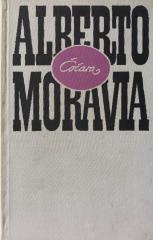
These collections are key to understanding Moravia's "Roman phase" (along with The Roman Woman and The Čočara) – a portrait of a society in transition, where war trauma turns into moral indifference and materialism. They influenced Italian neorealism and later literature about "little people".
One copy is available