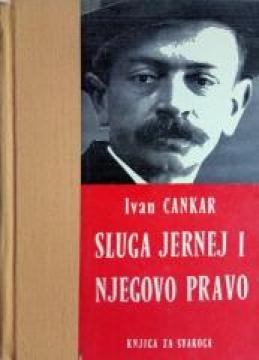
Sluga Jernej i njegovo pravo

Sluga Jernej i njegovo pravo

Ivan Cankar

This story symbolizes the little man's struggle for social justice and dignity.

The plot follows an old servant Jernej who has served faithfully on the estate of old Sitarj his entire life (forty years). Jernej believes that his work entitles him to a home, but after the old master's death, the young heir kicks him out of the estate because he considers him a useless burden. Jernej sets out in search of "his right" (right), visiting various institutions: The Church and the mayor: Where he encounters misunderstanding and bureaucracy. The court in the city (Ljubljana): Where they explain to him that the law protects property, not the work of a servant. Vienna (to the emperor): Jernej eventually goes even to the emperor, the symbol of the highest justice, but finds no help there either. After realizing that human laws do not know justice for the poor, Jernej returns to the village and in despair sets fire to Sitarj's estate, after which the villagers throw him into the fire. Jernej symbolizes the oppressed worker and the working class. He does not seek alms, but recognition that he co-created the estate with his work. Young Sitar represents a new, soulless capitalism that does not care about tradition or human merit, but only about profit and ownership papers. The central motif that Jernej understands morally (the right to the fruits of labor), while the system interprets it exclusively through legal paragraphs and ownership. The work criticizes a social system in which the law is on the side of the rich, while the worker has no protection. Cankar, through Jernej's tragedy, points to a deep gap between ethical justice and state law.

Translation
Đuza Radovć i Dimitrije Vučenov
Dimensions
17 x 12 cm
Pages
191
Publisher
Nolit, Beograd, 1970.
 
Latin alphabet. Hardcover.
Language: Serbian.

Multiple copies are available

Copy number 1

Condition:Used, excellent condition

Copy number 2

Condition:Used, excellent condition
Damages or inconvenience notice:
  • Traces of patina

Copy number 3

Condition:Used, very good condition
 

Are you interested in another book? You can search the offer using our search engine or browse books by category.

You may also be interested in these titles

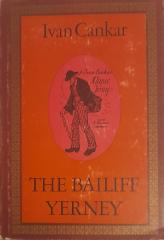
The Bailiff Yerney and His Rights

The Bailiff Yerney and His Rights

Ivan Cankar
Državna založba Slovenije, 1968.
English. Latin alphabet. Hardcover with dust jacket.
14.99
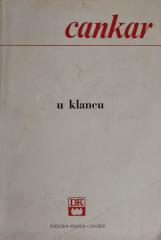
U klancu

U klancu

Ivan Cankar

"In the Gorge" is a novella written by Slovenian writer Ivan Cankar, one of the author's most famous works. It was published in 1900 and is one of the key works of Slovenian modern literature.

Školska knjiga, 1974.
Croatian. Latin alphabet. Paperback.
3.00 - 3.22
Štefica Cvek u raljama života

Štefica Cvek u raljama života

Dubravka Ugrešić

Do you like "lovelies"? Whatever you think about them, you'll enjoy this superb pastiche of trivial romance novels.

Mladinska knjiga, 1990.
Croatian. Latin alphabet. Hardcover with dust jacket.
4.94
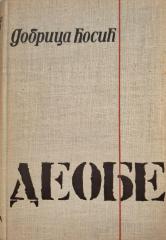
Deobe

Deobe

Dobrica Ćosić

Deobe is a novel about the tragic division of Serbs into Chetniks and Partisans during World War II. Winner of the NIN Award, it is part of a wider epic trilogy, inspired by Ćosić's experiences and historical documents.

Prosveta, 1963.
Croatian. Latin alphabet. Hardcover with dust jacket.
13.74
Malena je ime tanga

Malena je ime tanga

Almudena Grandes

If you like raw eroticism like Cloud Atlas, this is a sensual saga – emotional, provocative, for those who want to feel the pulse of forbidden passion! Grandes probes whether love is a curse or a liberation?

Mozaik knjiga, 2000.
Croatian. Latin alphabet. Hardcover.
8.54
V.

V.

Thomas Pynchon

The novel represents a journey into an alternative world – a world that we all belong to from time to time, but of which we would not want to be a part, a world of paranoia and alienation that we are not entirely sure is just an alternative or the bare tr

Čarobna knjiga, 2010.
Serbian. Latin alphabet. Paperback.
21.98