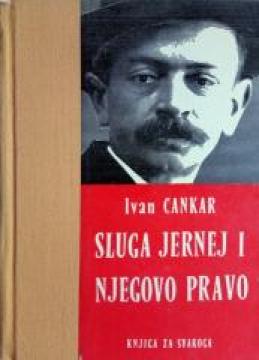
Sluga Jernej i njegovo pravo

Sluga Jernej i njegovo pravo

Ivan Cankar

This story symbolizes the little man's struggle for social justice and dignity.

The plot follows an old servant Jernej who has served faithfully on the estate of old Sitarj his entire life (forty years). Jernej believes that his work entitles him to a home, but after the old master's death, the young heir kicks him out of the estate because he considers him a useless burden. Jernej sets out in search of "his right" (right), visiting various institutions: The Church and the mayor: Where he encounters misunderstanding and bureaucracy. The court in the city (Ljubljana): Where they explain to him that the law protects property, not the work of a servant. Vienna (to the emperor): Jernej eventually goes even to the emperor, the symbol of the highest justice, but finds no help there either. After realizing that human laws do not know justice for the poor, Jernej returns to the village and in despair sets fire to Sitarj's estate, after which the villagers throw him into the fire. Jernej symbolizes the oppressed worker and the working class. He does not seek alms, but recognition that he co-created the estate with his work. Young Sitar represents a new, soulless capitalism that does not care about tradition or human merit, but only about profit and ownership papers. The central motif that Jernej understands morally (the right to the fruits of labor), while the system interprets it exclusively through legal paragraphs and ownership. The work criticizes a social system in which the law is on the side of the rich, while the worker has no protection. Cankar, through Jernej's tragedy, points to a deep gap between ethical justice and state law.

Prevod
Đuza Radovć i Dimitrije Vučenov
Dimenzije
17 x 12 cm
Broj strana
191
Izdavač
Nolit, Beograd, 1970.
 
Latinica. Tvrde korice.
Jezik: Srpski.

Više primeraka je u ponudi

Primerak broj 1

Stanje:Korišćeno, u odličnom stanju
Dodato u korpu!

Primerak broj 2

Stanje:Korišćeno, u odličnom stanju
Oštećenja / nepogodnosti:
  • Traces of patina
Dodato u korpu!

Primerak broj 3

Stanje:Korišćeno, u vrlo dobrom stanju
Dodato u korpu!
 

Zanima Vas i neka druga knjiga? Možete pretražiti našu ponudu pomoću pretrage ili prelistati knjige po kategorijama.

Možda će Vas zanimati i ovi naslovi

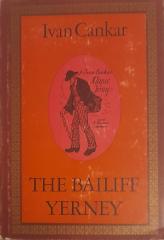
The Bailiff Yerney and His Rights

The Bailiff Yerney and His Rights

Ivan Cankar
Državna založba Slovenije, 1968.
Engleski. Latinica. Tvrde korice s omotom.
14,99 €
U klancu

U klancu

Ivan Cankar

"In the Gorge" is a novella written by Slovenian writer Ivan Cankar, one of the author's most famous works. It was published in 1900 and is one of the key works of Slovenian modern literature.

Školska knjiga, 1974.
Hrvatski. Latinica. Broširano.
3,00 - 3,22 €
Krčma

Krčma

Julian Stryjkowski

The book "Inn" by Julian Stryjkowski, published in 1977, explores life in a small Jewish village in Galicia during the 19th century.

BIGZ, 1977.
Srpski. Latinica. Broširano.
4,38 €
Malena je ime tanga

Malena je ime tanga

Almudena Grandes

Ako volite sirovu erotičnost poput Atlasa oblaka, ovo je senzualna saga – emotivna, provokativna, za one koji žele osjetiti puls zabranjene strasti! Grandes sondira je li ljubav prokletstvo ili oslobođenje?

Mozaik knjiga, 2000.
Hrvatski. Latinica. Tvrde korice.
7,96 - 8,54 €
Godan

Godan

Munshi Prem Chand
Kosmos, 1960.
Srpski. Latinica. Broširano.
4,22 - 4,26 €
Lope de Aguirre - Princ slobode

Lope de Aguirre - Princ slobode

Miguel Otero Silva

„Lope de Aguirre, Prinz der Freiheit“ ist ein Spiegelbild der Existenz der amerikanischen Gemeinschaft und der Entstehung einer großen Einzelfigur, die in der Welt des Blutes und der Übertretung die Ausmaße einer poetischen Allegorie annimmt.

Otokar Keršovani, 1983.
Hrvatski. Latinica. Tvrde korice s omotom.
8,98 €