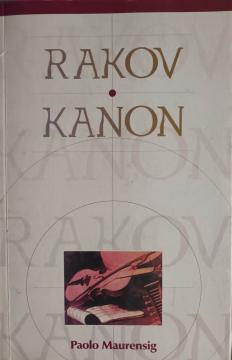
Rakov kanon

Rakov kanon

Paolo Maurensig

In the elegant London Dorchester Hotel, the new owner of a three-hundred-year-old Stainer violin will witness a gloomy story told to him by a writer whose desire was to write a novel in which the main character would be music.

This psychological and musical tale is structured like a musical canon, where themes are repeated and reversed, creating a layered narrative about identity, art, and destiny. The story begins in 1985 at the Dorchester Hotel in London, where the new owner of a three-hundred-year-old Stainer violin becomes the listener of an unusual story told to him by a writer obsessed with the idea of ​​writing a novel in which music is the main character.

Through this story, we meet two young musicians from Vienna in 1932: a Hungarian violinist and an Austrian aristocrat. Their connection is based on a shared passion for music, but also on complex relationships of friendship, jealousy, and competition. As their lives intertwine, secrets about their origins, family ties, and personal demons are revealed, culminating in tragic consequences.

The title of the novel refers to the musical form "crab canon," where the melody is played backwards, symbolizing the thematic reversal and reflection within the story. Maurensig uses this structure to explore how the past shapes the present and how art can be a source of both salvation and destruction.

Canon of the Crab is a deeply emotional novel that explores complex human emotions and relationships through musical metaphor, leaving the reader with questions about identity, legacy, and the power of art.

Original title
Canone inverso
Translation
Morana Čale
Editor
Sanja Pavić, Gordana Farkaš Sfeci
Graphics design
Palete design
Dimensions
22.5 x 14.5 cm
Pages
163
Publisher
Fidas, Zagreb, 2000.
 
Distribution: 1,000 copies
 
Latin alphabet. Paperback.
Language: Croatian.
ISBN
9-53-656111-5

No copies available

The last copy was sold recently.


Are you interested in another book? You can search the offer using our search engine or browse books by category.

You may also be interested in these titles

Tamnica: fragmenat naših mladih života

Tamnica: fragmenat naših mladih života

Zlatko Milković
Be-l-ka, 1942.
Croatian. Latin alphabet. Hardcover.
The book consists of two volumes
13.99
Djela #17: U svijetu

Djela #17: U svijetu

Maksim Gorki

„U svetu“ je drugi deo autobiografske trilogije Maksima Gorkog, objavljene 1916. godine. Trilogija obuhvata dela „Detinjstvo”, „U svetu” i „Moji univerziteti”, pružajući uvid u godine formiranja autora.

Kultura, 1949.
Croatian. Latin alphabet. Hardcover.
3.94 - 3.99
El Hakim

El Hakim

John Knittel

Knjiga „El Hakim“ Džona Knitela jedan je od njegovih najpoznatijih romana, koji kombinuje egzotično okruženje Egipta sa univerzalnim temama čovečanstva, medicine, morala i duhovnosti.

Mladost, 1969.
Croatian. Latin alphabet. Hardcover with dust jacket.
3.98
Divlji kvas

Divlji kvas

Ivica Đikić

Ivica Đikić u Divljem kvasu maestralno, sa dosta humora i gorčine, oživljava atmosferu palanačkog grada u kome svako svakoga poznaje, i gde se prošlost i sadašnjost ne mogu razdvojiti

Fraktura, 2024.
Croatian. Latin alphabet. Hardcover with dust jacket.
13.76
Dnevnik Očenašeka

Dnevnik Očenašeka

Vjekoslav Majer
Hrvatska književna naklada neovisnih književnika, 1938.
Croatian. Latin alphabet. Hardcover.
7.99
Licem prema buri

Licem prema buri

Josip Cazi
Matica hrvatska, 1960.
Croatian. Latin alphabet. Hardcover.
4.99