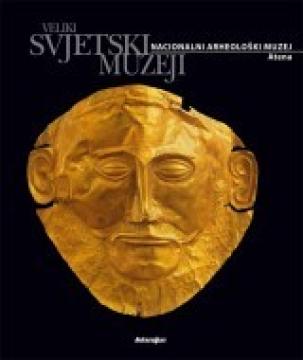
Veliki svjetski muzeji: Nacionalni arheološki muzej, Atena

Veliki svjetski muzeji: Nacionalni arheološki muzej, Atena

Cecilia de Meo

Various collections unfold from hall to hall of the Archaeological Museum, creating a fresco of Greek civilization whose various artistic expressions merge into an inextricable bond.

The Neolithic collection, with objects found at the Thessalian sites, and especially in Seskl and Dimini, along with painted ceramics, offers the observer the first examples of plastic expression in small statues that were created according to the motif of the Mother Goddess. The Cycladic collection is an expression of the culture that developed in antiquity on the islands of that archipelago and consists of marble statuettes with depictions of idols in rigid and abstract forms. The beautiful wall paintings from the village of Akrotiri on Thira, today's Santorini, are an excellent example of a refined civilization that developed the techniques and motifs of great Cretan painting. The royal tombs in Mycenae stand out for their incredible wealth as part of the Mycenaean collection, the first of its kind in the world, which is still being enriched with new objects. The museum also preserves a sculpture collection that contains the greatest masterpieces of antiquity and uniquely encompasses the development of Greek art from the first monumental sculptures to Hellenistic and Roman era sculptures. We thus see the development of their relationship to the human figure in space, the gradual adoption of anatomy, all the way to the formulation of the canon of proportions.

There is also a collection of ceramic objects through which it is possible to follow the development of Greek ceramic art and the progressive development of the techniques that accompany it. Collections of bronzes, jewelry and numismatics complete the rich content of this museum.

Entering the halls of the Athens Archaeological Museum means embarking on an incredible journey to discover our identity through the poetics that marked the Mediterranean and European identity and laid the foundation for the entire European art.

Übersetzung
Srećko Jurišić
Editor
Gordan Zečić
Maße
23 x 19,5 cm
Seitenzahl
142
Verlag
EPH media d. o. o., Zagreb, 2012.
 
Latein Schrift. Taschenbuch.
Sprache: Kroatisch.
ISBN
978-9-53338-028-5

Angeboten wird ein Exemplar

Zustand:Gebraucht, in ausgezeichnetem Zustand
Zum Warenkorb hinzugefügt!
 

Interessieren Sie sich für ein anderes Buch? Sie können das Angebot über unsere Suchmaschine suchen und finden oder Bücher nach Kategorien durchsuchen.

Diese Titel könnten Sie auch interessieren

Kodovi identiteta

Kodovi identiteta

Leonida Kovač's discourse is explicit and direct, almost bodily. It fills and disrupts space. Her theory mimics the work of the performative, it is active. It takes place in one moment and one place of utterance/pronunciation.

Meandar, 2001.
Kroatisch. Latein Schrift. Taschenbuch.
7,74
Istorija arhitekture stari vijek

Istorija arhitekture stari vijek

Husref Redžić

The author presents the main architectural styles, construction techniques, and cultural influences that have shaped architecture throughout history.

Zavod za izdavanje udžbenika, 1969.
Kroatisch. Latein Schrift. Fester Einband mit Schutzumschlag.
12,00
Kazalište misterija u Grčkoj: Tragedija

Kazalište misterija u Grčkoj: Tragedija

Jorge Angel Livraga

Kazalište misterija se razvilo iz eleuzinskih misterija i njihovog približavanja ljudima.

Nova akropola, 2000.
Kroatisch. Latein Schrift. Taschenbuch.
5,50
Hrvatsko lutkarstvo

Hrvatsko lutkarstvo

Antonija Bogner-Šaban, Dalibor Foretić, Livija Kroflin, Abdulah Seferović

The book monographically covers the entire puppet theatre in Croatia.

Hrvatski centar Unima, 1997.
Kroatisch. Latein Schrift. Taschenbuch.
10,20 - 10,22
Ludizam: zagrebački pojmovnik kulture 20. stoljeća

Ludizam: zagrebački pojmovnik kulture 20. stoljeća

What you have before you is not an ordinary collection – it is a vibrant, multidisciplinary map of a specific intellectual and artistic world: 20th-century Zagreb culture, seen through the prism of "Luddism" as a key, programmatic category.

Slon, 1996.
Kroatisch. Latein Schrift. Taschenbuch.
11,32
Hrvatsko slikarstvo XX. stoljeća, Svezak prvi

Hrvatsko slikarstvo XX. stoljeća, Svezak prvi

Grgo Gamulin

The first volume of Croatian Painting of the 20th Century by Grga Gamulin provides an overview of Croatian fine art from the Art Nouveau period to the interwar period, analyzing key authors and artistic movements.

Naprijed, 1987.
Kroatisch. Latein Schrift. Taschenbuch.
33,26