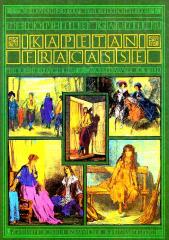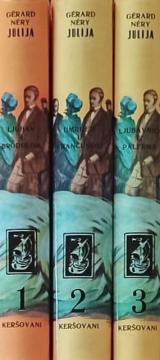
Julija 1-3

Julija 1-3

Gérard Néry

The novel's plot is set within the framework of historical events of the second half of the 19th century, intertwined with a love story and adventures of the young, underage, and madly in love Juliet, who nevertheless experiences her passions in a mature

Juliet has no parents, but she is rich, and her protector, the famous Parisian financier Gaspard, takes care of her money and upbringing. This beautiful and lovely girl moves in the most elegant circles of the French capital, is seen at the court of Emperor Napoleon III, has every chance of marrying richly and becoming a member of the Parisian social elite...

But love changes the course of her life. She falls in love with the young and handsome officer Alain Delatouche, who is very ambitious and wants to make a great career for himself, which is why he sets off for Mexico with the expeditionary corps that Napoleon III sends to help Maximilian.

Juliet breaks up with Alain. She is devastated by the sudden end of her newly begun love, and decides to remain faithful to her pain and unfulfilled love. After some time, this love burns even stronger in the beautiful heroine when she learns that her chosen one has disappeared in the fighting with the rebels in Mexico and is probably captured. The beautiful Julia decides to go to Mexico, in search of Alain. And so begins her great adventure…

After secretly preparing to escape. Julia boards a ship for Mexico. On board, she meets a young journalist, Raoul. Their acquaintance soon turns into love… However, the journey promises no happiness; the ship is damaged by a storm, and then destroyed by the explosion of ammunition intended for the French army in Mexico. Only Julia is miraculously saved and finally arrives in New York on the deck of an English warship.

In Paris, they learn of her escape, the shipwreck, and later of Julia's rescue. Her protector informs the French consul, who is supposed to meet her in New York. But Julia eludes him...

Original title
Julie Crèvecoeur
Translation
Ivo Bakotić
Dimensions
20 x 12 cm
Pages total
1101
Publisher
Otokar Keršovani, Rijeka, 1973.
 
Latin alphabet. Hardcover with dust jacket.
Language: Croatian.

The book consists of 3 volumes.

Jedan višetomni primjerak je u ponudi.

Julija 1-3
Volume 1
Pages: 359
Condition:Used, excellent condition
Julija 1-3
Volume 2
Pages: 413
Condition:Used, excellent condition
Julija 1-3
Volume 3
Pages: 329
Condition:Used, very good condition
 

Are you interested in another book? You can search the offer using our search engine or browse books by category.

You may also be interested in these titles

Lady Hamilton

Lady Hamilton

Alexandre Dumas

The novel represents one of Dumas' lesser-known, but still very interesting historical-biographical novels.

Epoha, 1966.
Croatian. Latin alphabet. Hardcover with dust jacket.
4.78
Čovek od gipsa

Čovek od gipsa

Joseph Kessel

The novel, whose original title is L'Homme de plâtre, explores complex human destinies through the story of a protagonist whose life symbolically reflects fragility and vulnerability, like plaster.

Minerva, 1987.
Serbian. Latin alphabet. Hardcover.
4.64
Kleopatra: Egipatska kraljica

Kleopatra: Egipatska kraljica

Claude Ferval

The novel tells the lavish story of the last Egyptian queen, a woman of exceptional intelligence and beauty, whose life, love affairs with Caesar and Antony, and tragic death symbolize the collision of power, passion, and fate.

Alfa, 1985.
Croatian. Latin alphabet. Hardcover with dust jacket.
8.34
Pričaj im o bitkama, kraljevima i slonovima

Pričaj im o bitkama, kraljevima i slonovima

Mathias Énard

In 1506, Michelangelo Buonarroti was invited by Sultan Bayezid II to design a bridge across the Golden Horn in Constantinople. Furious at Pope Julius II who had humiliated him and refused to pay, Michelangelo left Rome and arrived by ship in Constantinopl

Profil Knjiga, 2012.
Croatian. Latin alphabet. Paperback.
7.44 - 7.46
Evgenija Grande / Muzej starina

Evgenija Grande / Muzej starina

Honore de Balzac

In his novels Eugenie Grandet (1833) and The Museum of Antiquities (1837), Balzac explores universal themes of greed, human passions, sacrifice, and moral dilemmas, placing them in different social contexts of 19th-century French society.

Svjetlost, 1963.
Croatian. Latin alphabet. Hardcover.
3.48
Veliko zaveštanje

Veliko zaveštanje

François Villon
Srpska književna zadruga (SKZ), 1960.
Serbian. Cyrillic alphabet. Hardcover.
8.64