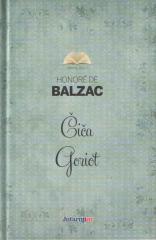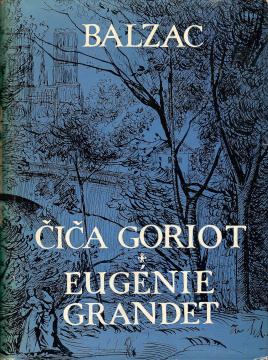
Čiča Goriot / Eugenie Grandet

Čiča Goriot / Eugenie Grandet
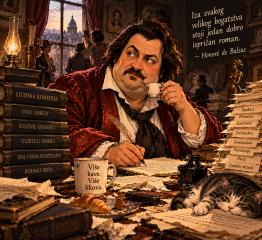
Honore de Balzac

Together, Uncle Goriot and Eugenie Grandet deliver Balzac's powerful portrayal of the power of money, family relationships, and social ambitions, revealing how greed, love, and sacrifice shape human destinies.

Balzac's works Père Goriot and Eugène Grandet, collected in one book, represent two extremely important novels from the human comedy of French realism. Although different in atmosphere and plot, both works are connected by a deep interest in the power of money, social rise, family ties and the moral price of ambition.

In Père Goriot, Balzac depicts Parisian society as a place of relentless struggle, hypocrisy and social cruelty. The fate of the old Goriot, who completely exhausts himself in love with his daughters, reveals the tragic power of parental sacrifice in a world in which feelings increasingly give way to interests. At the same time, through the character of Eugène de Rastignac, the novel also brings one of the most striking images of youthful ambition and entry into a society shaped by money, connections and cold calculation.

Eugène Grandet is a more intimate and peaceful novel, but equally sharp in its depiction of human relationships. At the center is young Eugenie, whose kindness, sensitivity, and capacity for love stand in contrast to the hardness, stinginess, and spiritual closure of her father. Here, Balzac brilliantly demonstrates how wealth does not necessarily bring breadth or nobility, but can become a means of emotional repression and the closure of life.

Together, these two novels provide a striking picture of a society in which money penetrates family, love, and morality. Balzac remains an exceptional observer of human weakness, but also of rare nobility, and this book still seems powerful, convincing, and surprisingly contemporary today.

Naslov originala
Le Père Goriot / Eugénie Grandet
Prevod
Ivan Čaberica
Naslovnica
Boris Dogan
Dimenzije
20,5 x 15 cm
Broj strana
428
Izdavač
Naprijed, Zagreb, 1967.
 
Latinica. Tvrde korice s omotom.
Jezik: Hrvatski.

Jedan primerak je u ponudi

Stanje:Nekorišćeno
Dodato u korpu!
 

Zanima Vas i neka druga knjiga? Možete pretražiti našu ponudu pomoću pretrage ili prelistati knjige po kategorijama.

Možda će Vas zanimati i ovi naslovi

Čiča Goriot

Čiča Goriot

Honore de Balzac

Uncle Goriot is the story of the old war profiteer Goriot and his daughters, who, after robbing him to the point of being naked, leave him to die in the solitude and misery of the Vaquer boarding house. It is a story that can be read today on several leve

Europapress holding, 2008.
Hrvatski. Latinica. Tvrde korice.
6,32 - 6,99
Sjaj i bijeda kurtizana

Sjaj i bijeda kurtizana

Honore de Balzac

The Splendor and Misery of a Courtesan is part of Balzac's collection The Human Comedy. The novel follows the fate of Lucien de Rubempré, an ambitious young poet, and his relationship with the mysterious Vautrin, an ex-convict, in the world of Parisian de

Globus, 2004.
Hrvatski. Latinica. Tvrde korice.
4,76 - 4,82
Čiča Gorio

Čiča Gorio

Honore de Balzac

Uncle Goriot is the story of the old war profiteer Goriot and his daughters, who, after robbing him to the point of being naked, leave him to die in the solitude and misery of the Vaquer boarding house. It is a story that can be read today on several leve

Rad, 1961.
Srpski. Latinica. Broširano.
1,99
Četrdeset pet vitezova, sv. 1-2

Četrdeset pet vitezova, sv. 1-2

Alexandre Dumas

Alexandre Dumas – The Forty-Five Knights, published in 1966, is part of a grand trilogy about the political and religious turmoil in France during the late 16th century.

Epoha, 1966.
Hrvatski. Latinica. Tvrde korice s omotom.
Knjiga se sastoji od dva toma
9,48
Baselska zvona

Baselska zvona

Louis Aragon

The novel follows three women: Diane, a noblewoman; Catherine Simonidzé, a feminist; and the real Clara Zetkin, a communist. Through their destinies, the crisis of bourgeois society, women's emancipation, and the path to communism are depicted.

Kultura, 1946.
Srpski. Latinica. Tvrde korice.
5,76
Robin Hood

Robin Hood

Alexandre Dumas

Dumas portrays Robin Hood not only as a bandit who helps the poor, but also as a heroic fighter for justice and a symbol of resistance to feudal injustice.

Epoha, 1966.
Hrvatski. Latinica. Tvrde korice s omotom.
4,26 - 4,82