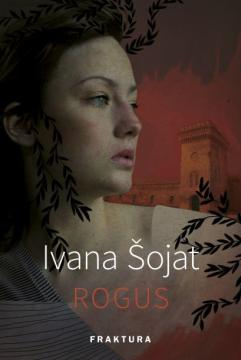
Rogus

Rogus

Ivana Šojat

In Rogus, Ivana Šojat fascinatingly combines two worlds, two Osijeks, contemporary and baroque, and tells the story of women who are still fighting for their positions in a man's world, just as they did almost three hundred years ago.

Young archaeologist Angelina Pavković from Osijek is at a turning point in her life: she loves her job, but everything else has become a rut. She is aware that it can't go on like this. Žarko wants to enroll in a doctorate, but he cannot find a common language with his partner, promising physicist Jakov. When she discovers a place where witches were burned in a locality in Osijek, her life turns upside down. She is interested in the case of her namesake, Anica Pavković, the last witch burned in Osijek in 1738. Suddenly, everything becomes clearer, her dreams and what is happening around her. She begins to wonder if she is her reincarnation, who is Jakov, and who are her friends, high school teacher Jasna, with whom she has been friends since childhood, fellow archaeologist Igor and others around her... The heroines of Rogus are real in their fears, as well as in to their strength to endure the cruelest tortures and defeat death, as the last "witch", and to fight for themselves, their dreams, love and passion like Angelina.

"Women are more susceptible to sin, that's the attitude, I find. Women are suspicious in all their states. Widows, unmarried, poor, but also those rich who can take care of themselves, thin, women with strange hairstyles, rebellious, those who gave birth to too many, but also those who have too few children, who did not give birth, those who dared to sow a field with different seeds, who touched a dead pig, who wear clothes made of many kinds of cloth, women who have a mole or a wart, raped women. They can all be witches. It is enough to point your finger at one of them. Because everyone will eventually admit it. He has to admit."

Editor
Seid Serdarević
Graphics design
Ivana Jurić
Dimensions
21 x 14 cm
Pages
216
Publisher
Fraktura, Zaprešić, 2023.
 
Latin alphabet. Hardcover with dust jacket.
Language: Croatian.
ISBN
978-9-53358-604-5

No copies available

The last copy was sold recently.


Are you interested in another book? You can search the offer using our search engine or browse books by category.

You may also be interested in these titles

Pohvala duhu rugajućem

Pohvala duhu rugajućem

Rade Vojvodić
Minerva, 1978.
Serbian. Latin alphabet. Paperback.
3.99
Virusi

Virusi

Borivoj Radaković

"Viruses" is a novel about the intimacy of a fifty-year-old, about marriage, relationships between people, love, work, erotica, art... against disease, death, violence, politics, war.

Europapress holding, 2005.
Croatian. Latin alphabet. Paperback.
3.88
Anđeoska ljubav

Anđeoska ljubav

Susan Elizabeth Phillips

Spoiled Daisy marries cold Alex to avoid prison. He, a trainer in a traveling circus, takes her to a world of tents and animals. Conflicts turn into fiery love. Hilarious romantic comedy about transformation and true relationship.

Mozaik knjiga, 2012.
Croatian. Latin alphabet. Paperback.
7.26
Mrtvi kapitali

Mrtvi kapitali

Josip Kozarac

"Dead Capitals" (1890) is one of the most important works of Croatian realism and a strong critique of the social stagnation of the time. The novel shows the economic and social neglect of Slavonian villages under the Austro-Hungarian Empire through the c

Mladost, 1971.
Croatian. Latin alphabet. Hardcover.
3.56 - 6.22
Slobodni pad

Slobodni pad

Pavao Pavličić

Pavličić's novel deals with the psychological and ethical consequences of human choices in extreme circumstances. It is not just a novel about a man in crisis, but also a study of how a person reacts when they lose their support - in themselves, in others

Znanje, 1982.
Croatian. Latin alphabet. Hardcover with dust jacket.
6.46
Taida: roman iz aleksandrijskih vremena

Taida: roman iz aleksandrijskih vremena

Anatole France

The novel Taida, published in 1890, is one of the most famous works by French Nobel Prize winner Anatole France. The work is inspired by the legend of Saint Taida of Egypt, a 4th-century courtesan who converted to Christianity.

Rad, 1961.
Serbian. Latin alphabet. Paperback.
1.99