Bijeg
Rijetka knjiga

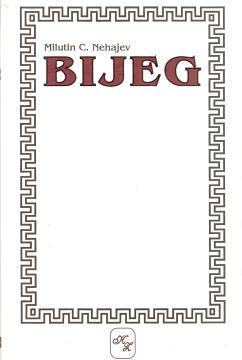
Bijeg

Milutin Cihlar Nehajev

A psychological novel about the downfall of the gifted intellectual Đuro Andrijašević, who flees from reality but finds no salvation in either the city or the province. A classic of Croatian modernism (1909).

The 1996 edition, adapted from the 1917 edition, has once again brought to life one of the most important novels of Croatian literary modernity. The work was first published in 1909 and is considered the best novel of Croatian modernity.

The novel follows the life of Đuro Andrijašević, a gifted but emotionally unstable young intellectual. The plot begins on the train on which Đuro returns from Vienna to Slavonia, and is mostly told through his memories, diary entries and internal monologues. The reader follows his childhood in Senj, his education in Rijeka and Vienna, his student days, love affairs (Zora, Vera), financial and existential crises and finally the life of a provincial professor in Senj.

Nehajev masterfully depicts defabularization – the plot is slower, and the emphasis is on psychological analysis, the state of consciousness and the internal conflicts of the main character. Đuro is a typical superfluous man of modernity: talented, sensitive, full of ideals, but unable to face the reality of a petty-bourgeois environment, financial problems and social expectations. His escape from reality (into alcohol, literature, love or the provinces) ends tragically – in decline and complete impotence.

The work contains strong autobiographical elements (Nehajev, like Đuro, studied in Vienna, lived in the provinces and dealt with internal crises). It combines social criticism, psychological depth and modern storytelling techniques (monologues, letters, diary). Critics often compare it to the works of Turgenev, Flaubert and Goncharov (Oblomov).

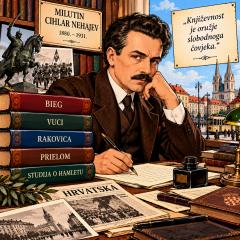
Today, Escape is considered a classic reading and one of the most representative works depicting the crisis of the intellectual at the turn of the 19th and 20th centuries in Croatian society. With this novel, Nehajev (1880–1931) left a deep mark as a prominent representative of Croatian modernism – a novelist, playwright, and critic.

Dimenzije
21 x 14 cm
Broj strana
165
Nakladnik
Katarina Zrinska, Zagreb, 1996.
 
Latinica. Tvrde korice.
Jezik: Hrvatski.

Jedan primjerak je u ponudi

Stanje:Nekorišteno
Dodano u košaricu!
 

Zanima Vas i neka druga knjiga? Možete pretražiti našu ponudu pomoću tražilice ili prelistati knjige po kategorijama.

Možda će Vas zanimati i ovi naslovi

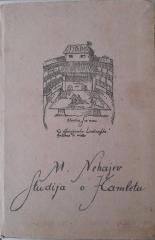
Studija o Hamletu

Studija o Hamletu

Milutin Cihlar Nehajev

„Eine Studie über Hamlet“ (1917) ist eine psychologisch-kritische Analyse von Shakespeares Meisterwerk. Nehajev interpretiert die Figur Hamlet als modernen Intellektuellen – passiv, übelwollend, zynisch und fatalistisch –, der mit einer korrupten Welt kon

Nakladni zavod Jug, 1917.
Hrvatski. Latinica. Tvrde korice.
29,99
Vuci

Vuci

Milutin Cihlar Nehajev

„Vukovi“ je roman Milutina Cihlara Nehajeva koji istražuje složene međuljudske odnose i moralne dileme kroz priču o vuku, simbolu divljine i slobode.

Spektar, 1974.
Hrvatski. Latinica. Tvrde korice.
2,68 - 3,76
Rakovica: o 60. godišnjici smrti Eugena Kvaternika

Rakovica: o 60. godišnjici smrti Eugena Kvaternika

Milutin Cihlar Nehajev

Nehajeva „Rakovica“, u izdanju koje je priredio Blaž Jurišić, predstavlja Rakovičku bunu, njene uzroke i ideje. Nehajev nije završio knjigu zbog iznenadne smrti; završio ju je i priredio Blaž Jurišić.

Matica hrvatska, 1932.
Hrvatski. Latinica. Tvrde korice.
5,42 - 8,266,20
Rudnik čvaraka

Rudnik čvaraka

Tomislav Šovagović

Debitantsko delo hrvatskog pisca Tomislava Šovagovića, nagrađeno nagradom Josipa i Ivana Kozarca 2012. godine, jeste posveta Slavoniji – kraju njegovog detinjstva koji autor, rođen u Dalmaciji, posmatra stranim, ali nežnim očima.

Mozaik knjiga, 20112.
Hrvatski. Latinica. Broširano.
11,56
Deobe 1-3

Deobe 1-3

Dobrica Ćosić

Ovo delo, nagrađeno NIN-ovom nagradom za tu godinu, smatra se jednim od najznačajnijih u srpskoj književnosti posle Drugog svetskog rata. Prvo izdanje.

Prosveta, 1961.
Srpski. Ćirilica. Tvrde korice s ovitkom.
Knjiga se sastoji od tri toma
11,42
Zagrepčanka

Zagrepčanka

Branislav Glumac

Branislav Glumac je 1974. godine objavio roman bez tačaka i zareza, kao neumoljivi tok misli mladog buntovnika. Objavljeno u socijalističkoj Jugoslaviji, delo je izazvalo skandal svojom otvorenošću i postalo klasik o generacijskoj pobuni.

IROS, 1986.
Hrvatski. Latinica. Tvrde korice.
8,24