
Bijeg
Rare book

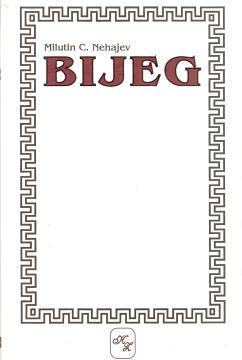
Bijeg

Milutin Cihlar Nehajev

A psychological novel about the downfall of the gifted intellectual Đuro Andrijašević, who flees from reality but finds no salvation in either the city or the province. A classic of Croatian modernism (1909).

The 1996 edition, adapted from the 1917 edition, has once again brought to life one of the most important novels of Croatian literary modernity. The work was first published in 1909 and is considered the best novel of Croatian modernity.

The novel follows the life of Đuro Andrijašević, a gifted but emotionally unstable young intellectual. The plot begins on the train on which Đuro returns from Vienna to Slavonia, and is mostly told through his memories, diary entries and internal monologues. The reader follows his childhood in Senj, his education in Rijeka and Vienna, his student days, love affairs (Zora, Vera), financial and existential crises and finally the life of a provincial professor in Senj.

Nehajev masterfully depicts defabularization – the plot is slower, and the emphasis is on psychological analysis, the state of consciousness and the internal conflicts of the main character. Đuro is a typical superfluous man of modernity: talented, sensitive, full of ideals, but unable to face the reality of a petty-bourgeois environment, financial problems and social expectations. His escape from reality (into alcohol, literature, love or the provinces) ends tragically – in decline and complete impotence.

The work contains strong autobiographical elements (Nehajev, like Đuro, studied in Vienna, lived in the provinces and dealt with internal crises). It combines social criticism, psychological depth and modern storytelling techniques (monologues, letters, diary). Critics often compare it to the works of Turgenev, Flaubert and Goncharov (Oblomov).

Today, Escape is considered a classic reading and one of the most representative works depicting the crisis of the intellectual at the turn of the 19th and 20th centuries in Croatian society. With this novel, Nehajev (1880–1931) left a deep mark as a prominent representative of Croatian modernism – a novelist, playwright, and critic.

Dimensions
21 x 14 cm
Pages
165
Publisher
Katarina Zrinska, Zagreb, 1996.
 
Latin alphabet. Hardcover.
Language: Croatian.

One copy is available

Condition:Unused
 

Are you interested in another book? You can search the offer using our search engine or browse books by category.

You may also be interested in these titles

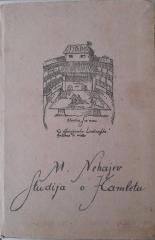
Studija o Hamletu

Studija o Hamletu

Milutin Cihlar Nehajev

A Study of Hamlet (1917) is a psychological-critical analysis of Shakespeare's masterpiece. Nehajev interprets the character of Hamlet as a modern intellectual – passive, ill-willed, cynical and fatalistic, faced with a corrupt world.

N. Z. "JUG", 1917.
Croatian. Latin alphabet. Hardcover.
29.99
Vuci

Vuci

Milutin Cihlar Nehajev

"Wolves" is a novel by Milutin Cihlar Nehajev that explores complex interpersonal relationships and moral dilemmas through the story of a wolf, a symbol of wilderness and freedom.

Spektar, 1974.
Croatian. Latin alphabet. Hardcover.
2.68 - 3.76
Rakovica: o 60. godišnjici smrti Eugena Kvaternika

Rakovica: o 60. godišnjici smrti Eugena Kvaternika

Milutin Cihlar Nehajev

Nehajev's "Rakovica", in the edition edited by Blaž Jurišić, presents the Rakovica Rebellion, its causes and ideas. Nehajev did not finish the book due to his sudden death; it was completed and edited by Blaž Jurišić.

Matica hrvatska, 1932.
Croatian. Latin alphabet. Hardcover.
5.42 - 8.266.61
Deobe

Deobe

Dobrica Ćosić

Deobe is a novel about the tragic division of Serbs into Chetniks and Partisans during World War II. Winner of the NIN Award, it is part of a wider epic trilogy, inspired by Ćosić's experiences and historical documents.

Prosveta, 1963.
Croatian. Latin alphabet. Hardcover with dust jacket.
13.74
Štefica Cvek u raljama života

Štefica Cvek u raljama života

Dubravka Ugrešić

Do you like "lovelies"? Whatever you think about them, you'll enjoy this superb pastiche of trivial romance novels.

Mladinska knjiga, 1990.
Croatian. Latin alphabet. Hardcover with dust jacket.
4.94
V.

V.

Thomas Pynchon

The novel represents a journey into an alternative world – a world that we all belong to from time to time, but of which we would not want to be a part, a world of paranoia and alienation that we are not entirely sure is just an alternative or the bare tr

Čarobna knjiga, 2010.
Serbian. Latin alphabet. Paperback.
21.9819.78