Dječak iz pećine

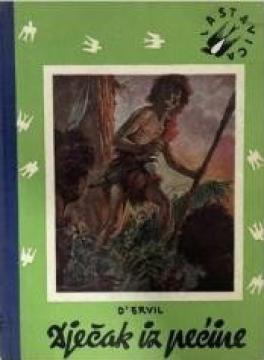
Dječak iz pećine

Ernest D'hervilly

The boy Krek keeps a fire in his cave, but carelessly extinguishes it. Exiled from his tribe, he goes through a series of dangerous adventures in prehistoric France, matures and proves his worth.

The Boy in the Cave (1888) is an adventure story for young people by Ernest d’Hervilly, considered his most successful work. The story is set in the Late Paleolithic, approximately 25,000 years ago, in what is now France.

The main character is a nine-year-old boy Krek, a smart and brave boy from a tribe of cavemen (Cro-Magnons). The tribe entrusts him with the most precious thing – guarding the fire in the cave hearth while the adults go hunting. Krek, however, plays and the fire goes out. In prehistoric times, this is a serious crime because fire means warmth, protection from wild beasts, cooking food and the survival of the entire tribe. As punishment, the boy is exiled from the community.

Alone in the harsh nature, Krek faces numerous dangers: hunger, cold, wild animals (mammoths, rhinoceroses, cave lions), conflicts with other tribes and his own fear. Traveling through forests, plains, and caves, he learns to make stone tools, hunt, navigate nature, and survive. He meets friendly characters, including an old man who helps him, and even members of other groups (e.g., the lake people).

The novel simultaneously depicts the growth and maturation of the main character. Through difficult trials, Krek becomes stronger, wiser, and more responsible. The author emphasizes the importance of community – in the end, the tribe forgives Krek's transgression, and he returns as a useful member of society.

D'Hervilly wrote the story under the influence of contemporary discoveries in archaeology and Darwin's theory of evolution. Although some details are scientifically outdated today (e.g., the depiction of the Cro-Magnons), the book comes alive thanks to vivid descriptions of nature, animals, and the daily lives of prehistoric people. The style is dynamic, adventurous, and instructive, with an emphasis on courage, ingenuity, and human solidarity.

The Boy from the Cave is a pioneering work in the genre of prehistoric literature for children. In its Croatian translation, it was popular reading, stimulating imagination and interest in the distant past of humanity.

Titel des Originals
Aventures d’un petit garçon préhistorique en France
Übersetzung
Živojin Vukadinović
Editor
Ahmet Hromadžić
Illustrationen
Željko Marjanović
Titelseite
Željko Marjanović
Maße
20 x 14 cm
Seitenzahl
115
Verlag
Narodna prosvjeta, Sarajevo, 1959.
 
Latein Schrift. Hardcover.
Sprache: Kroatisch.

Angeboten wird ein Exemplar

Zustand:Gebraucht, in ausgezeichnetem Zustand
Nachteile/Unannehmlichkeiten:
  • Traces of patina
Zum Warenkorb hinzugefügt!
 

Interessieren Sie sich für ein anderes Buch? Sie können das Angebot über unsere Suchmaschine suchen und finden oder Bücher nach Kategorien durchsuchen.

Diese Titel könnten Sie auch interessieren

Dječak iz pećine

Dječak iz pećine

Ernest d'Hervilly

The novel follows a boy from prehistoric times growing up in a harsh world defined by the struggle for survival. Through hunting, facing dangers, and encountering the natural world, he learns to survive and discovers the value of courage, knowledge, and c

Veselin Masleša, 1964.
Kroatisch. Latein Schrift. Hardcover.
5,323,72 €
Crveni i crni: Kronika XIX. stoljeća

Crveni i crni: Kronika XIX. stoljeća

Stendhal
Marie-Henry Beyle Stendhal

Julien Sorel, ein ehrgeiziger junger Mann einfacher Herkunft, versucht, in der Hierarchie der Restauration aufzusteigen, indem er der Kirche und dem Adel dient. Seine Liebesaffären mit Madame de Rênal und Mathilde de la Mole bringen ihn in einen Konflikt

Državno nakladno poduzeće Hrvatske, 1952.
Kroatisch. Latein Schrift. Fester Einband mit Schutzumschlag.
6,24 €
Legenda o lijepom Pécopinu i lijepoj Bauldouri

Legenda o lijepom Pécopinu i lijepoj Bauldouri

Hugo
Victor Hugo

Eine romantische Erzählung von Victor Hugo, der 21. Brief aus seinem Reisebericht „Le Rhin“ („Der Rhein“, 1842). Ein romantischer Klassiker, ähnlich den Märchen der Brüder Grimm oder Andersen, jedoch geprägt von Hugos tiefer Emotionalität und seiner Philo

Zora, 1951.
Kroatisch. Latein Schrift. Taschenbuch.
3,34 €
Banco: Sve ili ništa

Banco: Sve ili ništa

Henri Charrière

In seinem Buch „Banco – Alles oder Nichts“ beschreibt Henri Charrière sein Leben nach der Flucht aus dem Gefängnis in Französisch-Guayana. Auf der Suche nach Erlösung beginnt er ein ehrliches Leben, doch durch zahlreiche Abenteuer und zwielichtige Machens

Alfa, 1977.
Kroatisch. Latein Schrift. Fester Einband mit Schutzumschlag.
11,56 €
Crveni krin

Crveni krin

Anatole France

Die rote Lilie (1894) ist nicht nur eine Geschichte verbotener Leidenschaft – sie ist ein subtiles, ironisches Fresko einer Welt, in der Liebe, Politik und Kunst in einem dünnen, fast transparenten Netz aus Konventionen und Begierden miteinander verwoben

Svjetlost, 1961.
Serbisch. Latein Schrift. Hardcover.
2,34 - 4,26 €
Megre i sumnjičavi supružnici / Megre i mali ministrant

Megre i sumnjičavi supružnici / Megre i mali ministrant

Georges Simenon

Maigret deckt die Wahrheit in einer Ehe auf, in der Misstrauen und Angst die Grenze zwischen Realität und Fantasie verwischt haben.

Rad, 1969.
Serbisch. Latein Schrift. Taschenbuch.
5,00 €