Dječak iz pećine

Dječak iz pećine

Ernest D'hervilly

The boy Krek keeps a fire in his cave, but carelessly extinguishes it. Exiled from his tribe, he goes through a series of dangerous adventures in prehistoric France, matures and proves his worth.

The Boy in the Cave (1888) is an adventure story for young people by Ernest d’Hervilly, considered his most successful work. The story is set in the Late Paleolithic, approximately 25,000 years ago, in what is now France.

The main character is a nine-year-old boy Krek, a smart and brave boy from a tribe of cavemen (Cro-Magnons). The tribe entrusts him with the most precious thing – guarding the fire in the cave hearth while the adults go hunting. Krek, however, plays and the fire goes out. In prehistoric times, this is a serious crime because fire means warmth, protection from wild beasts, cooking food and the survival of the entire tribe. As punishment, the boy is exiled from the community.

Alone in the harsh nature, Krek faces numerous dangers: hunger, cold, wild animals (mammoths, rhinoceroses, cave lions), conflicts with other tribes and his own fear. Traveling through forests, plains, and caves, he learns to make stone tools, hunt, navigate nature, and survive. He meets friendly characters, including an old man who helps him, and even members of other groups (e.g., the lake people).

The novel simultaneously depicts the growth and maturation of the main character. Through difficult trials, Krek becomes stronger, wiser, and more responsible. The author emphasizes the importance of community – in the end, the tribe forgives Krek's transgression, and he returns as a useful member of society.

D'Hervilly wrote the story under the influence of contemporary discoveries in archaeology and Darwin's theory of evolution. Although some details are scientifically outdated today (e.g., the depiction of the Cro-Magnons), the book comes alive thanks to vivid descriptions of nature, animals, and the daily lives of prehistoric people. The style is dynamic, adventurous, and instructive, with an emphasis on courage, ingenuity, and human solidarity.

The Boy from the Cave is a pioneering work in the genre of prehistoric literature for children. In its Croatian translation, it was popular reading, stimulating imagination and interest in the distant past of humanity.

Original title
Aventures d’un petit garçon préhistorique en France
Translation
Živojin Vukadinović
Editor
Ahmet Hromadžić
Illustrations
Željko Marjanović
Graphics design
Željko Marjanović
Dimensions
20 x 14 cm
Pages
115
Publisher
Narodna prosvjeta, Sarajevo, 1959.
 
Latin alphabet. Hardcover.
Language: Croatian.

One copy is available

Condition:Used, excellent condition
Damages or inconvenience notice:
  • Traces of patina
 

Are you interested in another book? You can search the offer using our search engine or browse books by category.

You may also be interested in these titles

Madam Pompadur

Madam Pompadur

Jules de Goncourt, Edmond de Goncourt

Madame Pompadour (1878) by the Goncourt brothers follows the life of Jeanne-Antoinette Poisson, known as Madame de Pompadour (1721–1764), mistress of King Louis XV of France and one of the most influential women of the 18th century.

Epoha, 1966.
Serbian. Latin alphabet. Hardcover with dust jacket.
1.00 - 4.99
Pričaj im o bitkama, kraljevima i slonovima

Pričaj im o bitkama, kraljevima i slonovima

Mathias Énard

In 1506, Michelangelo Buonarroti was invited by Sultan Bayezid II to design a bridge across the Golden Horn in Constantinople. Furious at Pope Julius II who had humiliated him and refused to pay, Michelangelo left Rome and arrived by ship in Constantinopl

Profil Knjiga, 2012.
Croatian. Latin alphabet. Paperback.
7.44 - 7.46
Colomba

Colomba

Prosper Mérimée

Prosper Mérimée's novella, published in 1840, is set in Corsica and explores themes of revenge, honor, and the conflict between the traditional and modern worlds. The novella culminates in a tragic conflict, where love, duty, and violence intertwine.

Zora, 1950.
Croatian. Latin alphabet. Paperback.
2.44 - 2.48
Evgenija Grande / Muzej starina

Evgenija Grande / Muzej starina

Honore de Balzac

In his novels Eugenie Grandet (1833) and The Museum of Antiquities (1837), Balzac explores universal themes of greed, human passions, sacrifice, and moral dilemmas, placing them in different social contexts of 19th-century French society.

Svjetlost, 1963.
Croatian. Latin alphabet. Hardcover.
3.48
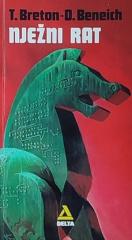
Nježni rat

Nježni rat

Thierry Breton, Denis Beneich
Mladost, 1987.
Croatian. Latin alphabet. Paperback.
4.82
Robin Hood

Robin Hood

Alexandre Dumas

Dumas portrays Robin Hood not only as a bandit who helps the poor, but also as a heroic fighter for justice and a symbol of resistance to feudal injustice.

Epoha, 1966.
Croatian. Latin alphabet. Hardcover with dust jacket.
4.26 - 4.82