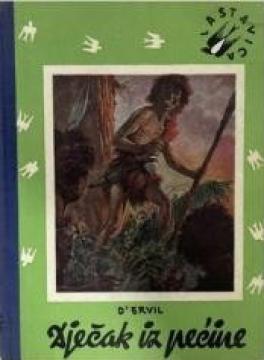
Dječak iz pećine

Dječak iz pećine

Ernest D'hervilly

The boy Krek keeps a fire in his cave, but carelessly extinguishes it. Exiled from his tribe, he goes through a series of dangerous adventures in prehistoric France, matures and proves his worth.

The Boy in the Cave (1888) is an adventure story for young people by Ernest d’Hervilly, considered his most successful work. The story is set in the Late Paleolithic, approximately 25,000 years ago, in what is now France.

The main character is a nine-year-old boy Krek, a smart and brave boy from a tribe of cavemen (Cro-Magnons). The tribe entrusts him with the most precious thing – guarding the fire in the cave hearth while the adults go hunting. Krek, however, plays and the fire goes out. In prehistoric times, this is a serious crime because fire means warmth, protection from wild beasts, cooking food and the survival of the entire tribe. As punishment, the boy is exiled from the community.

Alone in the harsh nature, Krek faces numerous dangers: hunger, cold, wild animals (mammoths, rhinoceroses, cave lions), conflicts with other tribes and his own fear. Traveling through forests, plains, and caves, he learns to make stone tools, hunt, navigate nature, and survive. He meets friendly characters, including an old man who helps him, and even members of other groups (e.g., the lake people).

The novel simultaneously depicts the growth and maturation of the main character. Through difficult trials, Krek becomes stronger, wiser, and more responsible. The author emphasizes the importance of community – in the end, the tribe forgives Krek's transgression, and he returns as a useful member of society.

D'Hervilly wrote the story under the influence of contemporary discoveries in archaeology and Darwin's theory of evolution. Although some details are scientifically outdated today (e.g., the depiction of the Cro-Magnons), the book comes alive thanks to vivid descriptions of nature, animals, and the daily lives of prehistoric people. The style is dynamic, adventurous, and instructive, with an emphasis on courage, ingenuity, and human solidarity.

The Boy from the Cave is a pioneering work in the genre of prehistoric literature for children. In its Croatian translation, it was popular reading, stimulating imagination and interest in the distant past of humanity.

Naslov izvornika
Aventures d’un petit garçon préhistorique en France
Prijevod
Živojin Vukadinović
Urednik
Ahmet Hromadžić
Ilustracije
Željko Marjanović
Naslovnica
Željko Marjanović
Dimenzije
20 x 14 cm
Broj strana
115
Nakladnik
Narodna prosvjeta, Sarajevo, 1959.
 
Latinica. Tvrde korice.
Jezik: Hrvatski.

Jedan primjerak je u ponudi

Stanje:Korišteno, u odličnom stanju
Oštećenja / nepogodnosti:
  • Traces of patina
Dodano u košaricu!
 

Zanima Vas i neka druga knjiga? Možete pretražiti našu ponudu pomoću tražilice ili prelistati knjige po kategorijama.

Možda će Vas zanimati i ovi naslovi

Crna lala

Crna lala

Alexandre Dumas

Cornelius van Berle, a young doctor from Dortrecht, is obsessed with creating a black tulip for the prize of the city of Harlem.

Nolit, 1966.
Srpski. Latinica. Tvrde korice.
2,98
Prijatelj Armenac

Prijatelj Armenac

Andreï Makine
Disput, 2023.
Hrvatski. Latinica. Broširano.
11,26
Život Byrona

Život Byrona

Andre Maurois

The biography The Life of Byron (1930) by André Maurois, is a detailed account of the life and works of the English Romantic poet George Gordon Byron (1788–1824).

Kultura, 1957.
Hrvatski. Latinica. Tvrde korice s ovitkom.
4,86 - 5,22
Filozofske priče

Filozofske priče

Honore de Balzac

Filozofske priče dio su Balzacove "Ljudske komedije", i obuhvaćaju četiri priče – Šangrinska koža, Eliksir dugog života, Nepoznato remek-djelo i Melmoth pokajnik – koje istražuju filozofske, moralne i metafizičke teme kroz složene likove i simbolizam.

Kultura, 1949.
Hrvatski. Latinica. Tvrde korice.
4,22 - 4,25
Robin Hood

Robin Hood

Alexandre Dumas

Dumas portrays Robin Hood not only as a bandit who helps the poor, but also as a heroic fighter for justice and a symbol of resistance to feudal injustice.

Epoha, 1966.
Hrvatski. Latinica. Tvrde korice s ovitkom.
4,26 - 4,82
Evgenija Grande / Muzej starina

Evgenija Grande / Muzej starina

Honore de Balzac

In his novels Eugenie Grandet (1833) and The Museum of Antiquities (1837), Balzac explores universal themes of greed, human passions, sacrifice, and moral dilemmas, placing them in different social contexts of 19th-century French society.

Svjetlost, 1963.
Hrvatski. Latinica. Tvrde korice.
3,48