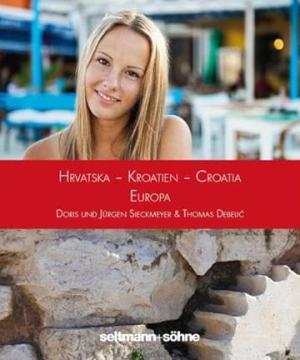
Hrvatska - Kroatien - Croatia - Europa

Hrvatska - Kroatien - Croatia - Europa

Doris Sieckmeyer, Jurgen Sieckmeyer, Thomas Debelić

The book contains 224 pages, sewing thread, 3 languages (Croatian, English, German), approx. 60 pages of text, over 190 color photos.

The average European has a clear picture of Croatia. It consists of a digitally processed aerial photograph of a green island surrounded by very blue water. There are no people anywhere, maybe a romantic sailboat appears. But this clichéd image is way off the mark. It has little to do with the country as it really is. Of course, there are those 1000 islands, and they are among the most beautiful in the world, but they are much more than "just" a paradise for tourists. Croatia is amazing and surprisingly diverse. And it is inhabited by wonderful, interesting, hospitable and sometimes idiosyncratic people. Croatia, the name itself, says a lot about the country. It starts very soft and warm, but ends hard, reflecting the complexity of this country. And yet, everything in Croatia fits together harmoniously, there is peace side by side and with each other. This is probably due to the fact that the country is located at the interface between the Balkans and Central Europe. That's what makes it so exciting. The question whether Croatia belongs to the Balkans or not is almost a matter of religion. "For me, the Balkans is an area where the Ottomans shaped the mentality for 500 years, that was not the case with the Croats," says Zagreb banker Baron Nikola Adamovič. "The local population differs from its eastern neighbors from those in Vojvodina, with the exception of its predominantly Occidental orientation throughout history and the consequent influence on science, art, culture and religion. East of the former Austro-Hungarian border, on the other hand, Byzantine influences and orientation towards the East were are dominant." And so in Croatia the advantages of both ways of life are combined in the most pleasant way, not only in the kitchen. Balkan tranquility meets Austrian bureaucracy. This country and its people enrich Europe with its melange of Mediterranean, Alpine, and Balkan essence.

Translation
Ivo Lovrić, Reinhold Tyrach, Petra Kruse
Illustrations
Jurgen Sieckmeyer
Dimensions
28.5 x 24.5 cm
Pages
224
Publisher
Seltman+Söhne, Ludenscheid, 2011.
 
Latin alphabet. Hardcover.
Language: Croatian.
ISBN
978-3-94283-129-1

One copy is available

Condition:Used, excellent condition
 

Are you interested in another book? You can search the offer using our search engine or browse books by category.

You may also be interested in these titles

Čaša puna zdravlja

Čaša puna zdravlja

In the book A glass full of health, you will find fantastic recipes for juices of all possible flavors full of vitamins, minerals, phytochemicals and enzymes - substances that do real wonders for your body.

Mozaik knjiga, 2014.
Croatian. Latin alphabet. Paperback.
9.95
Istina je u prirodi

Istina je u prirodi

Vladimir Gruden

The work combines medical, psychological and philosophical thinking and criticizes modern man's distance from the natural way of life.

Medicinski fakultet Sveučilišta u Zagrebu, 1992.
Croatian. Latin alphabet. Paperback.
4.75
Droga opća opasnost

Droga opća opasnost

Eda Vujević

This book is primarily intended for parents who do not yet have a drug problem with their children, or parents whose children are only of preschool or school age.

24 sata, 2000.
Croatian. Latin alphabet. Paperback.
3.00
Dobra kućanica: za žensku mladež

Dobra kućanica: za žensku mladež

Davorin Trstenjak

"The Good Housewife" by Davorin Trstenjak (1880, several editions) is a practical manual for girls and young women on household management, saving, morality and family life, especially intended for those of lower financial status.

Štamparija Karla Albrechta (Jos. Wittasek), 1897.
Croatian. Latin alphabet. Hardcover.
34.52
Kako se osloboditi...

Kako se osloboditi...

Rita Bennett

In modern life it is impossible to avoid stress. Whether its source is work, interpersonal relationships or money, we often fall into a vicious circle of senseless obsession with the wrong things, and we don't know how to get rid of them and in what order

Izvori, 1987.
Croatian. Latin alphabet. Paperback.
6.65
Osječki gradski muzej

Osječki gradski muzej

Franjo Buntak

Dr. Franjo Buntak (Zagreb, 1910–1985), an art historian and prominent museum expert, published a guide to the collections of the Osijek City Museum in 1940. The booklet contains an overview of the museum's history and the most important exhibits.

Društvo prijatelja starine Mursa, 1940.
Croatian. Latin alphabet. Paperback.
6.54