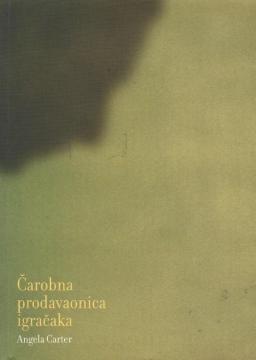
Čarobna prodavaonica igračaka

Čarobna prodavaonica igračaka

Angela Carter

The very beginning of The Magic Toy Store traces the story of young Melanie as a developmental novel that combines realistic motivation with narrative mechanisms characteristic of fairy tales.

McClane's position at the beginning corresponds to that of a princess in a fairy tale. It is a position of complete security and privilege, but in conflict with the absence of her parents, who are often absent from home and strangely uninterested in their own children. Melanie's first transgression, which she seeks to mark her coming of age (when she puts on her mother's wedding dress and stains it with her own blood), coincides with the death of her parents and her expulsion from her beautiful, fairy-tale house with a garden to her uncle's dark and mysterious house in the London suburbs, inhabited by a violent, monstrous uncle. his mute wife and her two brothers... Angela Carter's prose summarizes and elaborates on a more general narrative need for the miraculous and the fantastic and is therefore particularly important not only within British literary production, but also in the most broadly understood cultural history. No British author has been more ingenious - as a novelist, but also as a critic - than Angela Carter. Angela Carter's world is strange, dangerous and beautiful

Original title
The magic toyshop
Translation
Davorka Herceg Lockhart
Editor
Drago Glamuzina
Illustrations
Ivana Vučić
Dimensions
19.5 x 14.5 cm
Pages
201
Publisher
Profil International, Zagreb, 2003.
 
Latin alphabet. Paperback.
Language: Croatian.

One copy is available

Condition:Used, excellent condition
 

Are you interested in another book? You can search the offer using our search engine or browse books by category.

You may also be interested in these titles

Ljubičice u srijedu

Ljubičice u srijedu

Andre Maurois

André Maurois, a French writer known for his psychological novels and biographies, explores themes of family relationships, love, and internal conflicts in this work, which is characteristic of his style.

Svjetlost, 1965.
Croatian. Latin alphabet. Paperback.
3.42 - 3.62
V.

V.

Thomas Pynchon

The novel represents a journey into an alternative world – a world that we all belong to from time to time, but of which we would not want to be a part, a world of paranoia and alienation that we are not entirely sure is just an alternative or the bare tr

Čarobna knjiga, 2010.
Serbian. Latin alphabet. Paperback.
21.9816.49
Deobe

Deobe

Dobrica Ćosić

Deobe is a novel about the tragic division of Serbs into Chetniks and Partisans during World War II. Winner of the NIN Award, it is part of a wider epic trilogy, inspired by Ćosić's experiences and historical documents.

Prosveta, 1963.
Croatian. Latin alphabet. Hardcover with dust jacket.
13.74
Knjiga moga oca

Knjiga moga oca

Ethem Mandić

This is a biography about my father made up of memories and mere imagination. History does not exist, and neither do facts. The past is unknown.

OKF d.o.o, 2016.
Croatian. Latin alphabet. Paperback.
10.64
Proces

Proces

Franz Kafka

Kafka wrote The Process between 1914 and 1915, published posthumously in 1925. The novel is unfinished but with an added final chapter by Max Brod. Edition with a foreword by B. Živojinović and an afterword by Walter Killi.

BIGZ, 1990.
Serbian. Latin alphabet. Paperback.
4.26
Zagrepčanka

Zagrepčanka

Branislav Glumac

Branislav Glumac published a novel without periods or commas in 1974, as the relentless stream of thought of a young rebel. Published in socialist Yugoslavia, the work caused a scandal with its openness and became a classic about generational rebellion.

IROS, 1986.
Croatian. Latin alphabet. Hardcover.
8.24