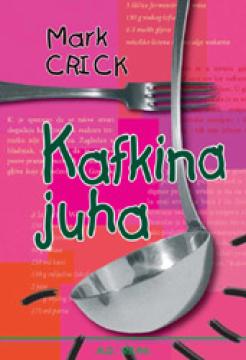
Kafkina juha: Cjelovita povijest svjetske književnosti u 14 recepata
Rare book

Kafkina juha: Cjelovita povijest svjetske književnosti u 14 recepata

Mark Crick

Mark Crick, a London photographer with an eye for the absurd, creates a humorous literary pastiche in the form of a cookbook. Instead of ordinary recipes, he offers 14 recipes written in the style and voice of the world's great writers - from antiquity to

Imagine an old-fashioned kitchen where on a wooden table is a book that looks like an ordinary cookbook, but smells of ink and irony. Open the page and Homer, in the rhythm of hexameters, describes how to cook a thick, fatty soup for Odysseus after ten years of wandering – with olives, onions and a touch of divine anger. Jane Austen, with subtle irony and restrained grace, suggests a light dinner for two who are just getting to know each other – with the obligatory consideration of the social status and marital potential of each ingredient. Franz Kafka, of course, turns the most ordinary hard-boiled egg into a painful, endless procedure: the shell peels off, but never completely, and the egg remains eternally inscrutable.

Raymond Chandler brings a noir salad – the carrots are suspicious, the cucumbers are silent, and the sauce hides a secret. Virginia Woolf stirs fish soup slowly, introspectively, while waves of memory break against the edge of the pot. Proust, of course, cannot do without the madeleine – but here it is only the beginning of an endless chain of flavors and memories. Even Irvine Welsh enters the kitchen – vulgar, raw, with a Scottish accent and throat-burning spices.

Each recipe is short, doable, but also a superb literary pastiche: the style, the rhythm, the tone, the author’s obsessions – it’s all there. Crick doesn’t just imitate; he brings them to life in the kitchen, where great literature meets the pot and pan. The book is witty, clever, a little cynical – ideal for those who like to read while cooking, or cook while reading. In the end, the taste remains: of laughter, irony and the wonderful thought that all of world literature is, in fact, just different ways of cooking something edible.

Original title
Kafka's Soup
Translation
Damir Biličić
Editor
Neven Antičević
Illustrations
Marina Leskovar
Dimensions
19 x 13 cm
Pages
92
Publisher
Algoritam, Zagreb, 2006.
 
Latin alphabet. Paperback.
Language: Croatian.

One copy is available

Condition:Unused
 

Are you interested in another book? You can search the offer using our search engine or browse books by category.

You may also be interested in these titles

Metamorfoze iliti pretvorbe

Metamorfoze iliti pretvorbe

Mario Kovač

The main motifs of the collection are love and everyday life, followed by poetry, and a subtle homage to Zagreb.

Što čitaš?, 2019.
Croatian. Latin alphabet. Paperback.
5.38
Uglavnom pridjevi

Uglavnom pridjevi

Hrvoje Jurić

The collection "Uglavnom adjevjevi" by Hrvoje Jurić brings together ten cycles of poetic sketches and poems.

Algoritam, 2014.
Croatian. Latin alphabet. Paperback.
8.146.11
Iza srca, grad kupina

Iza srca, grad kupina

Kristina Špiranec

This is a collection in which the city becomes an interlocutor, a space whose streets, parks and courtyards become places of encounter (with oneself).

Meandar, 2024.
Croatian. Latin alphabet. Paperback with dust jacket.
12.649.48
Dva puta za jug

Dva puta za jug

Lara Mitraković

The intense saturation and density of this poetry make it impossible to read this book in one sitting. It must be taken slowly and measuredly, as each poem requires a longer process of reception.

Fraktura, 2019.
Croatian. Latin alphabet. Hardcover with dust jacket.
7.98
Krvava knjiga

Krvava knjiga

Franjo Nagulov

Franjo Nagulov's new poetry collection, The Bloody Book, is a dark record of the decline of a society.

Durieux, 2024.
Croatian. Latin alphabet. Paperback.
8.96
Oganj i ruža - Pjesme narodne revolucije

Oganj i ruža - Pjesme narodne revolucije

Jure Kaštelan

The following pages are torn from the book of the people's revolution. From the book? No, from the womb, from the veins, from the bloodstream, from the roots of life. They are the history of love.

Kultura, 1956.
Croatian. Latin alphabet. Hardcover.
9.82