Glagoljska i ćirilska tabla za dicu
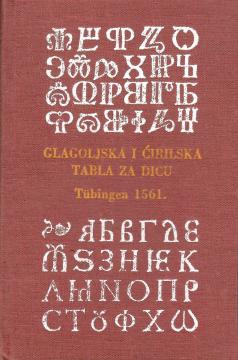
"Glagolitic and Cyrillic Tablet for Children" (reprint of the original Tübingen, 1561) is the oldest Croatian primer printed in Glagolitic and Cyrillic. An important monument of Croatian Protestant publishing and Slavic literacy.
Glagolitic and Cyrillic Children's Board is a facsimile (reprinted) edition of one of the oldest Croatian primers, published in 1986 in the Cymelia Croatica library as volume 3. It was edited and the afterword was written by the distinguished philologist Stjepan Damjanović.
The original was printed in 1561 in Tübingen (Germany) in the printing house of Croatian Protestants (Urach/Tübingen). It is the so-called Children's Board – a simple primer intended for learning to read and write in the Croatian language. There are two versions: one in Glagolitic and one in Cyrillic (Bosančica). It contains the alphabet, spelling syllables, and basic religious texts, typical of Protestant catechetical literature of the 16th century.
This edition has great cultural and historical significance because it testifies to the efforts of Croatian Protestants (Ante Dalmatin, Stjepan Konzul Istranin and others) to spread Reformation ideas and literacy among the population in the vernacular and native scripts (Glagolitic and Cyrillic). Tabla za dicu is considered one of the earliest systematic attempts to introduce public education in the Croatian language.
The 1986 edition belongs to the reputable Cymelia Croatica edition, which brought facsimiles of the most important Croatian old printed books. It is distinguished by its high-quality reproductions, scientific apparatus and afterword that contextualizes the monument within Croatian linguistic and literary history.
Today, this edition is a sought-after antiquarian copy, especially appreciated among philologists, paleographers, literary historians and lovers of Croatian Glagolitic and Cyrillic heritage. It represents an important bridge between medieval literacy and modern Croatian culture and demonstrates the richness and diversity of Croatian scripts in the 16th century.
One copy is available