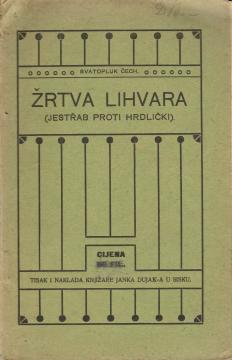
Žrtva lihvara
Rare book
Antique

Žrtva lihvara

Svatopluk Čech

Svatopluk Čech's novella depicts the conflict between the peaceful, honest manager of Hrdlička and the ruthless usurer Jestřáb. The story is a harsh social critique of usury, exploitation, and the downfall of the common man under the pressure of monetary

Svatopluk Čech (1846–1908), one of the most important Czech writers of the second half of the 19th century, known for his social commitment and satire, wrote the novella The Victim of the Moneylender (1876).

The work is a sharp socially critical novel that shows the conflict between two opposite characters and two worlds. The main character is Hrdlička, a calm, honest and somewhat weak manager of the estate at the old manor castle. After the owner's death, he remains without protection and falls into debt slavery with the unscrupulous loan shark Jestřáb (Jestřáb = hawk). The usurer systematically exploits him, takes away his property, destroys family peace and forces him into complete ruin.

Čech masterfully contrasts Hrdlička's kindness, naivety and passivity with Jestřáb's cold calculation, greed and heartlessness. The novella is a strong criticism of usury as a social scourge, capitalist exploitation and the decline of the rural and petty bourgeoisie in the era of Austro-Hungarian capitalism. The writer shows how money and power destroy morality, family and human dignity.

The style is realistic with elements of satire and humor, typical of Čech. The work is relatively short, dynamic and readable, with a clear tendency - the defense of a small, honest man against predatory capital. In Czech literature, it is considered one of the early socially engaged prose works of Svatopluk Čech, who was otherwise better known for his epic poetry (Slávie, Lešetínský kovář).

In the Croatian context at the beginning of the 20th century, such editions (popular editions like Dujak's) were intended for a wider audience and served to spread social awareness and realism among readers. The book is an antiquarian rarity today.

Original title
Jestřáb contra Hrdlička
Translation
Pavao M. Rakoš
Dimensions
19.5 x 12.5 cm
Pages
104
Publisher
Tisak i naklada knjižare Janka Dujaka, Sisak, 1910.
 
Latin alphabet. Paperback.
Language: Croatian.

One copy is available

Condition:Used, excellent condition
Damages or inconvenience notice:
  • Slight damage to the cover
 

Are you interested in another book? You can search the offer using our search engine or browse books by category.

You may also be interested in these titles

Veseli šalabahter

Veseli šalabahter

"Veseli šalabachter" is a witty, playful and very accessible collection that shows through humor how one can write about ordinary topics in a completely unexpected way.

Karitativni fond UPT, 2004.
Croatian. Latin alphabet. Paperback.
2.98
Gradić gdje je vrijeme stalo

Gradić gdje je vrijeme stalo

Bohumil Hrabal

Bohumil Hrabal, a Czech writer known for his lyrical grotesque and humor, in his novel The Town Where Time Stood Still evokes childhood in the small town of Libeň (part of Prague), where time seems to stand still in a magical but melancholic world.

Hena Com, 2006.
Croatian. Latin alphabet. Paperback.
7.62
Lucky Jim

Lucky Jim

Kingsley Amis

Regarded by many as the finest, and funniest, comic novel of the twentieth century, Lucky Jim remains as trenchant, withering, and eloquently misanthropic as when it first scandalized readers back in 1954.

Penguin Books Ltd, 1969.
English. Latin alphabet. Paperback.
5.454.09
Što je muškarac bez brkova: humoristički roman

Što je muškarac bez brkova: humoristički roman

Ante Tomić

When it was first published in 2000, Tomić's novel What is a Man Without a Mustache instantly became a bestseller, and over the next few years it went through a series of new editions, dramatizations, and a film adaptation. First edition.

Hena Com, 2000.
Croatian. Latin alphabet. Paperback.
15.24
Blefsikon: Menedžment

Blefsikon: Menedžment

John Courtis
Mladinska knjiga, 1994.
Croatian. Latin alphabet. Paperback.
2.46
Nevini lopovi: satire

Nevini lopovi: satire

Fadil Hadžić

The satirical stories of Fadil Hadžić, one of the most performed playwrights in our country, cover a wide spectrum of contemporary social, ideological, cultural and psychological peculiarities.

Globus, 1988.
Croatian. Latin alphabet. Hardcover with dust jacket.
8.24