Viva la muerte: Baal babilonski

Viva la muerte: Baal babilonski

Fernando Arrabal

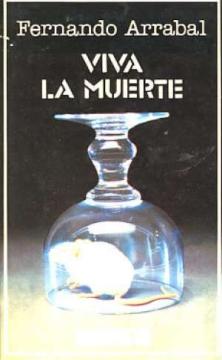
A sick young man recapitulates his upbringing in clerical-fascist Spain through memories and visions. This autobiographical novel served as a direct template for Arrabal's cult film Viva la muerte.

Viva la muerte: Baal Babylone (Baal Babylone, 1959) is an autobiographical novel by Fernando Arrabal, written in the form of an interrupted inner monologue. The protagonist, confined to a hospital bed, sank into memories of his childhood marked by the Spanish Civil War. Through fragments of memories, letters and feverish visions, the boy tries to fathom the fate of his anti-fascist father, who was reported to the clero-fascist regime by his own fanatically religious wife.

It was this novel that served as the main literary template according to which Arrabal directed his famous film debut Viva la muerte in 1971.

With a name that evokes ancient deities and biblical Babylon, the author describes the oppressive and morally depraved world in which he grew up. Applying the aesthetic principles of his Théâtre Panique (Théâtre Panique), Arrabal interweaves children's naivety, dark eroticism, dark humor, sacred iconography and grotesque violence. The novel provides a poignant analysis of a child's psyche torn between the desire for a mother's love and abhorrence of her betrayal, revealing how ideological fanaticism destroys the most intimate family relationships.

Original title
Baal Babylone
Translation
Ljiljanka Lovrinčević
Editor
Zdravko Židovec
Illustrations
Petar Dabac
Graphics design
Nenad Dogan
Dimensions
20 x 13 cm
Pages
166
Publisher
August Cesarec, Zagreb, 1981.
 
Latin alphabet. Hardcover with dust jacket.
Language: Croatian.

Two copies are available

Copy number 1

Condition:Used, excellent condition

Copy number 2

Condition:Used, good condition (visible signs of use)
Damages or inconvenience notice:
  • Library stamp
  • The cover is missing
Discounted price: 3.992.66
33% discount is valid until 12/31/26 11:59 pm
 

Are you interested in another book? You can search the offer using our search engine or browse books by category.

You may also be interested in these titles

Neprijatelj

Neprijatelj

Miguel Aranguren

Spanish author Miguel Aranguren, one of the leading novelists of his generation, creates a tense spiritual, deeply Christian police thriller that combines occultism, crime, and religious struggle.

Verbum, 2010.
Croatian. Latin alphabet. Hardcover.
11.268.45
Gola maja

Gola maja

Vicente Blasco Ibanez

The famous painter Mariano Renovales, the son of a blacksmith, rises to fame in Rome, Paris and Madrid. Obsessed with his love for women and art, he paints his "Naked Maya", which leads to drama, jealousy and conflict.

Zabavna biblioteka - Naklada tiskare Narodnih novina, 1924.
Croatian. Latin alphabet. Hardcover.
7.42
Krvava arena

Krvava arena

Vicente Blasco Ibanez

The Bloody Arena (1908) is a naturalistic novel about the rise and fall of bullfighter Juan Gallardo. A poor young man becomes a famous matador, but is destroyed by love, vice, fear, and tragedies in the arena – a critique of Spanish bullfighting and soci

Naprijed, 1984.
Croatian. Latin alphabet. Hardcover with dust jacket.
4.76
Tajna zelene ptice

Tajna zelene ptice

Luis Coloma

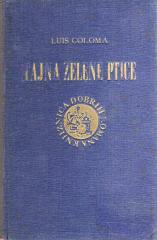
The Secret of the Green Bird (1910) is a novel by Spanish writer and Jesuit Luis Coloma, an author also known for the story of Ratoncito Pérez, about a young man from a Spanish aristocratic family who grew up without a mother under the influence of a domi

Hrvatsko književno društvo Sv. Jeronima, 1928.
Croatian. Latin alphabet. Hardcover.
4.72
Politički prvak

Politički prvak

José María Carretero

A political novel about the rise of an ambitious leader whose quest for power leads to intrigue, betrayal, and gradual moral collapse. A sharp, intriguing portrayal of politics as a dangerous game with no clear winners.

Savremena biblioteka, 1941.
Croatian. Latin alphabet. Hardcover with dust jacket.
8.42
Poljubac žene-pauka

Poljubac žene-pauka

Manuel Puig

The book, banned in Argentina from 1976 to 1983 due to its political and social themes, is considered Puig's most successful work. It was adapted into a film in 1985, a musical, and a stage play.

Prosveta, 1985.
Serbian. Latin alphabet. Hardcover with dust jacket.
4.84